February 9-15
If you prefer to listen over reading an article, keep an eye on Autumn Dickson on YouTube or various podcast platforms. I post video and podcast versions of my blog posts on my Youtube channel and on the podcast platforms: Apple, Anchor, Breaker, Google Podcasts, and Spotify.
Looking for a different week in the Come Follow Me program? Check out this link to find posts by week: https://autumndickson.com/category/come-follow-me/
Noah’s ark is one of the most classic bible stories. Even when you’re not Christian, many people are aware of the story and what it means. I read these verses in the last post for this week, and I’m going to read them again with a new angle.
Genesis 7:19-20, 23
19 And the waters prevailed exceedingly upon the earth; and all the high hills, that were under the whole heaven, were covered.
20 Fifteen cubits upward did the waters prevail; and the mountains were covered.
23 And every living substance was destroyed which was upon the face of the ground, both man, and cattle, and the creeping things, and the fowl of the heaven; and they were destroyed from the earth: and Noah only remained alive, and they that were with him in the ark.
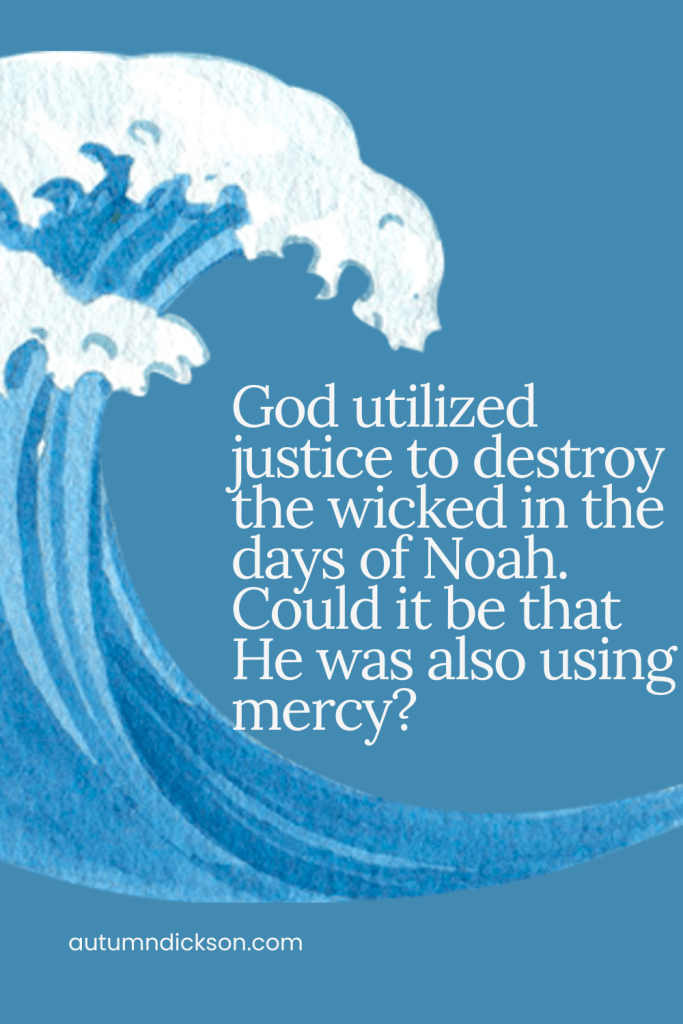
The Lord destroyed everything. Oftentimes, this is rightfully seen as an act of justice. According to the Come Follow Me manual, the flood was also an act of mercy. I love that justice and mercy often come together, and I want to expand upon that.
Here is a quote from the Come Follow Me manual. Elder Neal A. Maxwell taught, “corruption had reached an agency-destroying point that spirits could not, in justice, be sent here.” During Noah’s time, the world had become so dark and devastating that bringing new children into the world would have been wrong.
When you study child abuse and neglect, this makes complete sense. There comes a point when you are so traumatized that trauma is all you can offer others. And if there are no healthy adults to save the children, then society will just get darker and darker until it destroys itself anyway.
Perhaps God destroyed the evil, but they would have destroyed themselves anyway. Because of His decisions, He was also able to save many of the spirits that would have gone down and been destroyed alongside the rest.
Now this was an extremely large scale event, but that’s what makes it such an easy example to observe. Here is another scriptural example on a slightly smaller scale.
In The Book of Mormon, Nephi is teaching his brothers and trying to get them to repent, but they hate the things of God. Here is a verse that shows some of Nephi’s pleadings.
1 Nephi 17:45 Ye are swift to do iniquity but slow to remember the Lord your God. Ye have seen an angel, and he spake unto you; yea, ye have heard his voice from time to time; and he hath spoken unto you in a still small voice, but ye were past feeling, that ye could not feel his words; wherefore, he has spoken unto you like unto the voice of thunder, which did cause the earth to shake as if it were to divide asunder.
The Lord had to be severe to reach them. We see this over and over and over again throughout scripture. Paul the apostle, Alma the Younger, the Israelites all throughout the Old Testament. You will see this theme all throughout Come Follow Me this year. The Lord is willing to do what’s necessary in order to reach us, but there is an important, adjacent understanding that goes hand in hand with this.
He is not an offended tyrant. God is a loving Father, and He is wise enough to know how to reach His children. He’s not trying to punish us into submission. He’s trying to get through to us.
In 1 Peter, we learn that Christ went and preached to those in prison, specifically to the disobedient from the times of Noah. I wonder if they were finally ready to listen. I wonder if the flood and spirit prison reached them so that they were ready to live their life in a manner that brought happiness. I wonder if they are friends with Noah now. If they have repented, then I know this. They are grateful for the Lord and His wisdom in raining down justice and reaching them.
All of God’s decisions are based on love for His children, the seemingly severe and the softly spoken answer. He chooses the option that will most powerfully reach us. We’ve seen this on a large scale like with Noah and the flood, we’ve seen it on a smaller scale with Laman and Lemual. What does it mean for your own life?
We have to be careful not to take this principle beyond its proper bounds. The principle is this: God will use tragedy to reach us if it’s necessary because He loves us. The principle is not this: If you’re experiencing something tragic, it is because God is using tragedy to punish you or because you really need to repent. Tragedy does not equate to wickedness, but it can be a tool that God uses sometimes. It just depends.
I testify that all of God’s decisions are based on love. I testify that suffering in mortal life is not the worst thing that can happen to a person. I testify that death is not the worst thing that can happen to a person. I testify that God is wise enough to do what it takes to reach us, and I testify that He sent His Son to wash us, heal us, and suffer with us so that He could succor us when we’re prepared to accept that loving kindness. I testify that God uses justice to be merciful in our lives.
 Autumn Dickson
Thank you so much for your insights! Your thoughts helped me make peace with the Flood for the FIRST time in my life. You helped me see the mercy WITHIN the justice! I’m looking forward to using your insights in my Gospel Doctrine lesson this week. Thank you!
LikeLike
It was a big game changer for me too. It’s helped me see His love in all of the actions that He takes in my life, and it’s changed how I approach loving others in my relationships. Sometimes the most loving thing can be boundaries, correction, etc.
LikeLike
As I was reading this wonderful message, the word ripe came to my mind. There are many scriptures where being ripe is a good thing, but many others where ripe is a bad thing. Just a few are — ripe for destruction (D&C 61:31, Helaman 13:14), and fully ripe in iniquity (2 Nephi 28:16)
I think this next one explains it best.
1 Nephi 17:35 Behold, the Lord esteemeth all flesh in one; he that is righteous is favored of God. But behold, this people had rejected every word of God, and they were ripe in iniquity; and the fulness of the wrath of God was upon them; and the Lord did curse the land against them, and bless it unto our fathers; yea, he did curse it against them unto their destruction, and he did bless it unto our fathers unto their obtaining power over it.
Rejecting the great God of the universe brings consequences, (curses) against those who do, so that future generations can be blessed.
I don’t think it’s that we get what we deserve, but what we have earned!!
I loved your thoughts that the gospel was preached to the wicked in the time of Noah and perhaps they were ready to hear it and repent. It makes perfect sense to me that a wise, merciful and loving Heavenly Father would provide 70 x 7 (or even more) opportunities for all of his children to repent, make and keep covenants so blessings can come their way.
Thank you very much for your excellent messages.
LikeLike
I truly wonder if the opportunity to repent is always there but that many people will refuse it no matter what is presented to them. I’ve seen it happen in this life. It’ll certainly be curious to see how it goes on the other side.
LikeLiked by 1 person