March 16-22
If you prefer to listen over reading an article, keep an eye on Autumn Dickson on YouTube or various podcast platforms. I post video and podcast versions of my blog posts on my Youtube channel and on the podcast platforms: Apple, Anchor, Breaker, Google Podcasts, and Spotify.
Looking for a different week in the Come Follow Me program? Check out this link to find posts by week: https://autumndickson.com/category/come-follow-me/
Last week, we talked about some of the symbolism behind Joseph’s story. He offered food that filled the bellies of the Egyptians and saved them. Christ offers salvation, and we should be actively paying attention to whether we’re bringing the bread home or internalizing it and letting it fill us. We expanded this symbolism to missionary work; if we are full, people will come and see just like other countries traveled to Egypt for food.
This week, I want to expand upon that same symbolism again.
So here are the quick details of that story. Pharaoh has a dream that Joseph interprets. This dream warns Pharaoh that there will be seven years of plenty and seven years of severe famine. Pharaoh puts Joseph in charge of a food-saving program, and it works. The people are saved because a portion of food had been set aside during the years of plenty.
When the land was desolate, the people came in and started to buy food from Joseph. When they ran out of money, they started giving their cattle and flocks to pay for the food. Ultimately, even that becomes insufficient. Then this happens.
Genesis 47:18-20
18 When that year was ended, they came unto him the second year, and said unto him, We will not hide it from my lord, how that our money is spent; my lord also hath our herds of cattle; there is not ought left in the sight of my lord, but our bodies, and our lands:
19 Wherefore shall we die before thine eyes, both we and our land? buy us and our land for bread, and we and our land will be servants unto Pharaoh: and give us seed, that we may live, and not die, that the land be not desolate.
20 And Joseph bought all the land of Egypt for Pharaoh; for the Egyptians sold every man his field, because the famine prevailed over them: so the land became Pharaoh’s.
It is at this point in time that the Egyptians become serfs to Pharaoh. Serfdom is an important distinction from slavery, especially as it relates to our conversation today. It is much more accurate to call them serfs. They’re not going to be bought and sold at will, but they’re tied to the land they don’t own. They have the right to work that land and provide for themselves, and they give back 20% of their food to Pharaoh.
Let’s talk about the implications of this policy that Joseph put forth in the land of Egypt as it relates to the symbolism of our last post, namely the atonement of Jesus Christ.
Implication 1. We can’t afford the atonement of Jesus Christ.
Joseph saved Egypt as well as the surrounding countries and the House of Israel. Plain and simple, he saved them all, and he did it with generosity. He didn’t resent the Egyptians for not being able to afford the food he had saved. In fact, he rejoices that his brothers betrayed him so that he could be placed in a position to save everyone.
In the seven years of the famine, the people got to the point where they had nothing else to give. Even after devoting all of their money, cattle, flocks, and land, they still came up short. It was never going to be enough. Nowadays, we are encouraged to build up our own food storage and self-reliance, and there are different principles that come with that prophetic counsel. This story, however, does not play out like that. Joseph saved the food, not the citizens. This is indicative of the atonement of Jesus Christ.
Grace is free. No matter how much money we bring to the table, no matter how much we have saved up, it is insufficient to save us. Justice is a harsh master, and we don’t have the means to save ourselves. It’s impossible. Christ saved you. Yes, we believe that He judges us by our works, but the eternal truth stands: He saved us, and nothing we offer can ever pay that back.
Implication 2. None of this is our’s; we can only give of ourselves. Even then, we are not our own. We become stewards, and Christ is a generous benefactor.
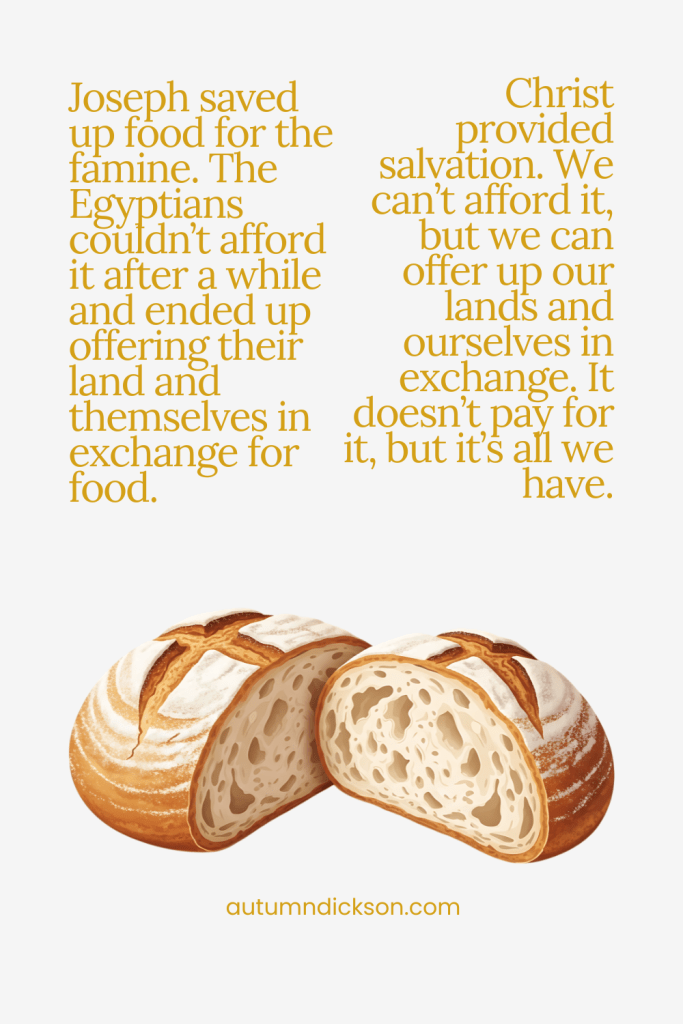
The food was not free. The Egyptians couldn’t afford it, and Joseph still offered it, but Joseph required something in return: their lands and themselves. The Egyptians agreed to this willingly.
Some people would call this coercion. How can you say no if your only other option is death? My response? That’s ridiculous. Why on earth would you be ungrateful? The best response you could have to this situation is, “Thank you. I couldn’t do this on my own. I couldn’t save myself. You saved me, and I will forever owe you for that. I recognize that I wouldn’t have anything without you, and so I willingly devote myself to give back some of what You gave me.”
In fact, this is how the Egyptians responded to their predicament.
Genesis 47:25 And they said, Thou hast saved our lives: let us find grace in the sight of my lord, and we will be Pharaoh’s servants.
Christ saves. We can resent Him for that. We can resent Him and falsely accuse Him of taking away our agency, but that’s not it at all. Joseph didn’t make them slaves so he could do whatever he wanted with them. He made them stewards and asked them to give back. He didn’t save them because he wanted to own them. He saved them so he could provide them with the opportunity to keep living.
Christ gave us an opportunity to make something of ourselves. He asks for a portion of what He gave us back. He asks us to devote ourselves and make the land fruitful. If we hate Him for it, then it’s tragically ironic. Not only does He own everything anyway, but He’s also trying to teach us how to make the best use of our land. He wants our land to be overflowing. He wants us to rejoice in what we’ve been given and gratefully give back. The more we do with what He has given, the more we have. Even when He asks for a portion back, it is actually continuing to serve us.
There are so many perfect, poignant details of Joseph’s story that teaches us about the atonement of Jesus Christ. It teaches things as they really are, and it gives us an opportunity to have the correct attitudes towards our true state of reality.
I testify that Christ can save us. We can reject His bread and try to find it elsewhere, but we’re going to come up empty. I testify that He didn’t perform the atonement so that He could own us and subject us to whatever He wanted. He performed the atonement so that our own agency didn’t ruin our eternity. He literally freed us, gave us more opportunity, and He teaches us how to make more of ourselves. We did not come out as slaves. Because of Jesus Christ, we have won.
 Autumn Dickson
Thank you so much Sister Autumn, I gave a talk last sunday by using your insights in our chapal.Everyone loved it. Have a great week Sister.
Regards Elder Sumith
LikeLike
I’m so grateful to hear that. I wish I could have heard some of their comments.
LikeLike
Absolutely brilliant!! This one goes right up there with Covid 19 and the Jaredites. Until now, that one was my all-time favorite. Now there is 1 and 1A and I have no idea on the order anymore!!
What a blessing to be a member of this Church!!
While reading, I thought of the statement by Elder Maxwell “In conclusion, the submission of one’s will is really the only uniquely personal thing we have to place on God’s altar. The many other things we “give,” brothers and sisters, are actually the things He has already given or loaned to us. However, when you and I finally submit ourselves, by letting our individual wills be swallowed up in God’s will, then we are really giving something to Him! It is the only possession which is truly ours to give!” (Swallowed Up in the Will of the Father Oct 1955)
For the first few years, those who came to Egypt to buy food did so out of their surplus. When all that was gone, they offered their bodies and lands. Both Jesus Christ and Lucifer want our lands and bodies, one for good and one for evil. One is creating serfs/servants who can later become Kings and Queens and the other seeking slaves, never to become anything else!! The choice is ours!!
Tonight my thoughts also turned to the Law of Consecration. For now, it is just a promise. When the time actually comes to give my EVERYTHING to the Savior, can I? Will I? I hope to be first in line. I can’t help but wonder how many will find that too much of a sacrifice and shrink? Grace is what we receive from a loving Heavenly Father. Faith — active faith is what we give back to Him in gratitude for the grace we have received.
Last week in our Teachers Council for Parents meeting we discussed the Holy Week Study Experience. I think you will find a blessing to your family About the Holy Week Study Experience as you prepare for Easter.
Thank you for a marvelous, insightful message. I am truly blessed.
LikeLike
What an insightful layer to add to this! Satan wants the same thing as Christ but for nefarious purposes.
As I think about the Law of Consecration, I think we can already offer it. Even if I need to go buy groceries from the store, I am still a steward utilizing the resources He gave me to feed my kids. I can ask myself on a daily basis what He would have me do with my time, energy, and resources. Sometimes that may mean multiplying what we’ve been give. Other times, it may mean giving. It can mean so many different things, and though I can’t sit before a bishop and offer what I have, I can sit before the Lord and ask Him to guide me. I did that with my time a lot when I was still trying to figure out these messages. I had to consecrate my time. Otherwise, I wouldn’t be able to do what I had to do. I was paying close attention, hour to hour, minute to minute, for Him to guide me on what I needed to prioritize at any given moment. He gave me back so much!
LikeLike