March 23-29
If you prefer to listen over reading an article, keep an eye on Autumn Dickson on YouTube or various podcast platforms. I post video and podcast versions of my blog posts on my Youtube channel and on the podcast platforms: Apple, Anchor, Breaker, Google Podcasts, and Spotify.
Looking for a different week in the Come Follow Me program? Check out this link to find posts by week: https://autumndickson.com/category/come-follow-me/
In our last post, we talked about how Moses turned to the Lord in despair. He had done what the Lord asked and told Pharaoh to free the Israelites. In response, Pharaoh gave them more work. Moses blamed himself and asked the Lord why He had been so cruel to His own people. In chapter 6, we get to read the Lord’s response to Moses.
He comforts Moses with assurances. He tells Moses that it’s not over; Pharaoh will relent, and the Israelites will yet be free.
The Lord then tells Moses to go and share this with the Israelites. Moses does so, and this is how the Israelites respond.
Exodus 6:9 And Moses spake so unto the children of Israel: but they hearkened not unto Moses for anguish of spirit, and for cruel bondage.
The Israelites were suffering so much that they had a difficult time believing that Moses would deliver them. There is a lot of depth here.
Let’s cover the first beautiful principle: The Lord saved them anyway. The Lord still kept sending Moses back. He kept sending miracles. He kept reaching out to those in bondage. He kept shining a light on them. Despite their lack of belief (which disbelief continues on even after the miracle of parting the Red Sea), the Lord kept reaching. He kept moving forward in saving them.
There are two parallels here.
Parallel one: The Savior suffered for all of us, not just the people He knew would accept His atonement. He didn’t look at each of us ahead of time and decide to only suffer for the people who were going to accept the saving. He suffered for everyone. Even those who did not or would not believe.
Parallel two: The Lord doesn’t wash His hands of us. Even when we wash our hands of Him (which is rather ironic), He doesn’t throw us over. When He steps back, it’s not due to annoyance or giving up. Stepping back is also one of the ways He reaches for us and tries to get us to see the truth of things.
The Israelites get a pretty bad rap throughout the Old Testament. They turn from the Lord frequently. They get distracted. They get the doctrine wrong and miss the mark.
They were also slaves. Their “cruel bondage” led to “anguish of spirit.” I’m not sure I would have fared much better had I been placed in their shoes. I think that’s partially why the Lord didn’t throw them off with the golden calf incident after showing them an incredible miracle with the Red Sea. The Lord knew what they were facing and what they were truly capable of. As a society, the Israelites didn’t know who they were anymore. They didn’t know the Lord or His goodness. Because of what they had been through, they didn’t have any sense that there was an all-powerful Being who might care for them and care about where they ended up.
They had a long way to go, and it started right here. They couldn’t find it within themselves to hope for deliverance through Moses, and so it started with the Lord sending miracles anyway.
Here is the second beautiful principle.
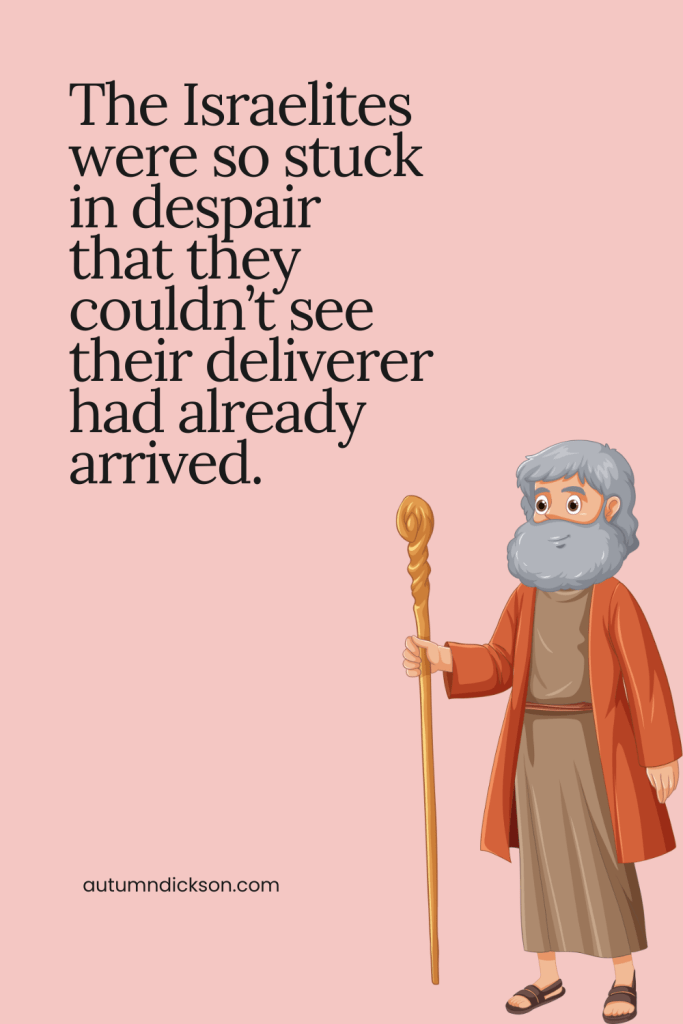
Their salvation was standing right in front of them even if they couldn’t see it. They were so broken that they couldn’t see their salvation. No judgment. I’m sure I would have been in a similar place had I been a slave. And yet, there is an implication for us here.
At what point have we reached “salvation?” When do we get to say, “I’m here. I’ve arrived. I’m saved.”?
I’m not sure there is a definitive level where you get to state that you’re saved. I think there are varying levels of salvation. Let’s talk about some of those different points of salvation.
Salvation 1: The Savior promised He was coming. The people don’t know it.
This is where we’re at in the Old Testament. Moses, their deliverer, is standing in front of them. He has been foreordained to save them, but they don’t know it. They’re too lost to feel it.
Interestingly enough, despite the fact that Moses technically hasn’t saved them yet, it’s as good as done when it comes to the Lord. If He has promised it, it’s as good as if it’s done, and so yes, this is a type of salvation. The Israelites are saved! Moses is here! Even if they don’t see it, they’re saved.
Salvation 2: The Savior promised He was coming, and there are people who do know it.
This is the next level, and we see this in The Book of Mormon. The Savior promised He was coming and would save; there are people who believed that so thoroughly that they acted as though He had already come. They believed so thoroughly in His ability to fulfill His promises, that it was as good as done, and they rejoiced.
Salvation 3: The Savior came and did His work, but the people don’t know it yet.
We see this all the time. This is as if Moses had opened the gates of Egypt, and there were people too busy slaving away for masters who no longer stood over them that they missed it.
The Savior has come, but there are many who don’t know it. This happens in the church and out of it. Even when we’ve been baptized and follow the commandments, sometimes we still don’t understand that we’ve been saved.
Salvation 4: The Savior came and did His work, and the people know it.
This one is self-explanatory. The Lord won, and we know it. This is the ultimate form of salvation.
I bring this up because there are two sides to the coin of salvation. There is the portion with Christ. There was a period of time before He came where His salvation was still a promise. That promise was as good as though it had already been done. When it comes to this side of the coin, we were always saved.
But then there is the other side of the coin.
Is salvation really salvation if we can’t enjoy it? Have we truly been saved if we’re still miserable because we don’t trust Him or because or our actions? It takes a long time for the Israelites to truly be saved. They make it out of Egypt, but they have not yet reached joy. They don’t know that the Lord is going to take care of them and lead them to that promised land. In that sense, salvation is a spectrum.
And let’s bring that full circle. The Israelites didn’t yet believe. They were in so much despair that they couldn’t bring themselves to believe. The Savior was going to keep sending miracles until they could see it. He paid for the salvation, and then He continues to reach out on top of it. He reaches and reaches until we finally see that the gates have been unlocked.
Where are you on the spectrum of salvation? The Savior has saved you. Do you see it? Do you see Him ready to lead you out of Egypt? Let Him heal the brokeness from the slavery. Let Him provide for you in the wilderness. Believe in His salvation so much that it’s as if you’re already in the promised land.
I testify that the Savior’s promises are solid. They are coming. We don’t have to live in despair even now because we have been taught what comes next. Even in our darkest moments (because dark moments aren’t evil), there is hope to temper it. We can rejoice. And if we’re still getting run over by life and can’t seem to lift up our heads and believe it, then hang tight. The Lord is sending miracles anyway until we do see it.
 Autumn Dickson