August 3-9
If you prefer to listen over reading an article, keep an eye on Autumn Dickson on YouTube or various podcast platforms. I post video and podcast versions of my blog posts on my Youtube channel and on the podcast platforms: Apple, Anchor, Breaker, Google Podcasts, and Spotify.
Looking for a different week in the Come Follow Me program? Check out this link to find posts by week: https://autumndickson.com/category/come-follow-me/
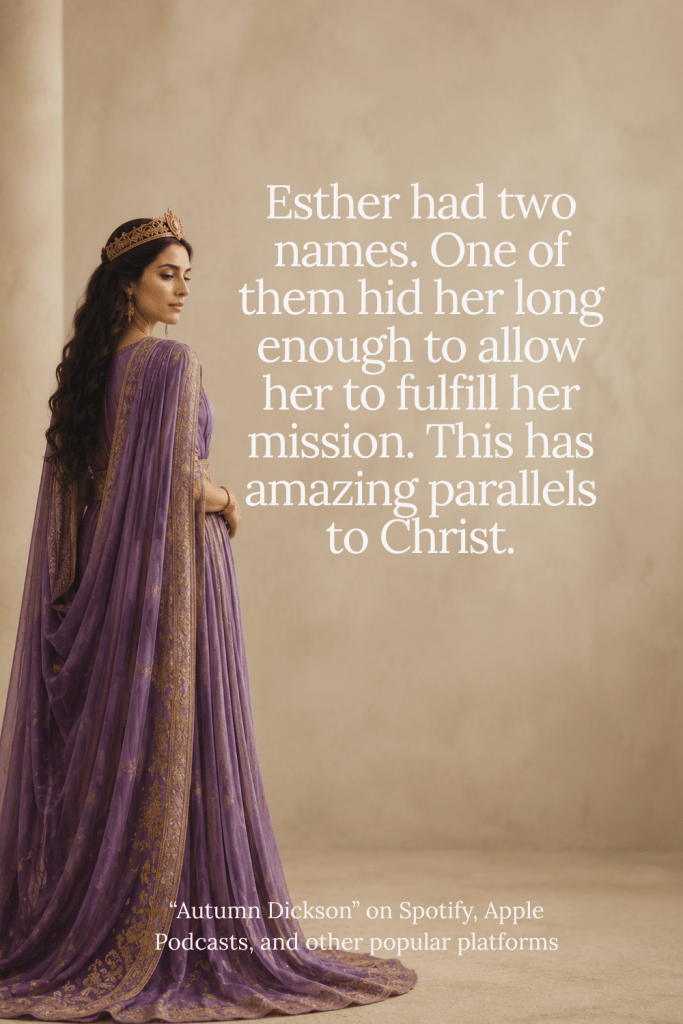
Esther’s story is one of courage. She is a remarkable woman who was placed in humble circumstances and rose to save her people. In a land that often looked down upon Jews, Esther’s heritage should have prevented her from being able to save her people. And yet, she rose to prominence was guided by the hand of the Lord. Here is one verse that introduces Esther and sets the foundation for what I want to talk about.
Esther 2:7 And he brought up Hadassah, that is, Esther, his uncle’s daughter: for she had neither father nor mother, and the maid was fair and beautiful; whom Mordecai, when her father and mother were dead, took for his own daughter.
In this verse, we learn that Esther’s given Hebrew name was “Hadassah.” In an effort to protect her, her name was changed to “Esther,” a Persian name. Jews were often looked down upon, discredited, and hated. Having a Persian name would have protected Esther from some of the prejudice she would face in court.
There is beautiful significance in the fact that Esther changed her name.
“Hadassah” means “myrtle.” The myrtle was a fragrant, humble evergreen plant often symbolizing righteousness, peace, beauty, or God’s people in biblical imagery. Esther was many of these things, and she rose to represent all of her people. The name “Esther” was also significant. Its Persian roots connect it to the word “star” which she certainly rose to be. Interestingly enough, the name “Esther” also has Hebrew roots, but those Hebrew roots mean “hidden.”
Esther’s names, with their many meanings, all tell her story very well. It also connects her back to Christ.
Esther was placed in a position to save her people. So much of her identity was “hidden” so that she could fulfill her role to save her people. Had her true identity been known, she may have been barred from being queen due to prejudice.
In the Old Testament, Christ is known as Jehovah, a latinized version of “YHWH.” This means, “I am.” It is a powerful statement of our Creator. It emphasizes self-existence, sovereignty, and eternal nature. When He comes to the earth, His name is revealed to Mary as “Jesus.” Jesus is the English version of Yeshua, which is a shortened version of Yehoshua. Yehoshua means “YHWH saves.”
When Christ came to earth, He did so quietly. Much of His identity was hidden. It was so hidden that the people in Nazareth, who knew Him while He was growing up, rejected Him thoroughly. They were angry when He claimed divine authority and purpose, and they tried to kill Him. If He had come in all of His glory, would things have been different? How would they have felt about Him then?
If He had come in all of His glory, He might not have been rejected and put in a position to save us.
On a broader note than Nazareth, many of the Jews didn’t recognize Him. They were looking for a powerful rebel who would throw off the Roman empire. They did not understand that Jesus was coming to save them in a more important way. Because He didn’t come in all of the glory that was due to Him, He was betrayed and rejected.
And though He didn’t deserve it, we needed it. We needed His true identity to be rejected so that He would be able to fulfill His atonement on our behalf. His “hidden” identity placed Him in a position to save the entirety of the human family.
Let’s take it a step further.
Esther’s hidden identity placed her in a position to save her people, but it wasn’t just her hidden identity. It was also her humility. Because of her docile and peaceful nature, the king really liked her. When she entered the throne room, the king extended his scepter towards her, sparing her life. Even after being spared, her humility continued. Rather than making a big fuss in the middle of court, she invited the king and Haman to a banquet. At the banquet, her request on behalf of her people was not widely viewed.
This likewise ties her to Christ.
When Christ saved the world, He did it quietly and without fanfare. As He suffered in the Garden of Gethsemane, He may have had an audience on the other side of the veil, but they were likewise hidden. His only companions fell asleep, and Christ accomplished His mission humbly. When it was all over, His success remained quiet as He was betrayed and taken to die. Not even His apostles seemed to understand just what He accomplished in that garden.
Both Esther and Christ had identities that were hidden that placed them in a position to save. Both Esther and Christ did so quietly and humbly, and this likewise enabled them to fulfill their missions.
What does this mean for us?
Each of us has a mission given to us by the Lord. We made promises before we came here. The Lord can place us in the position we need to be in to set us up for our mission. Regardless of whether we are born as an exiled, lowly orphan or born in a stable, He has the power to place us exactly where we need to be. Though it is counterintuitive, sometimes it is the very humble circumstances we are given that enables us to fulfill our own personal missions. Christ utilized kings like Cyrus and Hezekiah to save His people, but He also used those in the humblest circumstances to save His people. None of your circumstances matter; those are easy enough for the Lord to manipulate. What truly matters is whether you’re following the Savior.
Your mission may be quiet and humble, but if that is the case, then you are in good company. We don’t have to go over a loudspeaker to save His people. It doesn’t have to look outwardly dramatic. It doesn’t have to be filmed or livestreamed or hold a huge audience. We simply have to be willing to follow the Savior, and He will lead us to do good.
I testify that we can learn about Christ when we study the scriptures. I testify that everything was set up perfectly for Him to save us, not just with the alignment of circumstances in the New Testament, but also in your own personal life. There is a Plan of Salvation at large, and it has been successfully won. There is also a Plan of Salvation for you, and through the power of God, the circumstances can align for Him to save you too. We can trust Him.


Esther was my favourite character in Old Testament, thanks for sharing me about hidden names and their mission to fulfill. Both Christ and Esther.
It really uplifted me , thank you sister autumn, your insights and messages are always uplifts me everytime.
Thank you
Regards Elder Sumith
LikeLike
Esther was lovely and is one of my favorites too! Praying for you and your mission!
LikeLike
One of my very favorite scriptures is 2 Nephi 11:4 Behold, my soul delighteth in proving unto my people the truth of the coming of Christ; for, for this end hath the law of Moses been given; and all things which have been given of God from the beginning of the world, unto man, are the typifying of him.
There are many ways to summarize this verse. I prefer “all things testify of Christ”. You did a beautiful job of showing that Esther testifies of Christ. I especially loved your thoughts on her identity being hidden and her humility. As sons and daughters of Heavenly Parents, our identity is also intentionally hidden as part of the proving process (Abraham 3:25). Esther didn’t shrink from the daunting task that faced her. Neither should we.
I really, really enjoyed this message. Thanks for all you continue to do.
LikeLike
Loved the addition you tagged on there. Much of our identities are also hidden so that we can fulfill our own missions and grow as needed. Thanks friend.
LikeLike