June 29-July 5
If you prefer to listen over reading an article, keep an eye on Autumn Dickson on YouTube or various podcast platforms. I post video and podcast versions of my blog posts on my Youtube channel and on the podcast platforms: Apple, Anchor, Breaker, Google Podcasts, and Spotify.
Looking for a different week in the Come Follow Me program? Check out this link to find posts by week: https://autumndickson.com/category/come-follow-me/
There are major themes throughout the stories we read in the Old Testament. Some of the more negative themes are idolatry, fear over losing power, disobedience, and corrupting influences. The Old Testament does not shy away from showing the fallibility of humankind. There is great hope in faithful stories in the scriptures; there are also important warnings in the stories of people who were not obedient to the Lord.
One of the stories we read this week shows themes of obedience and disobedience. We see people who have a connection to God and follow Him, but we also watch them choose against God and find themselves in deep water because of it.
There are a lot of details for our story in this post, but stick with me. They are important because they set the stage for our principle.
In 1 Kings 13, we read about a man of God and an old prophet. Those are the only “names” we receive for these men, and these titles can get confusing especially when you’re reading the details of the story. Though they were labeled as a man of God and an old prophet, we see their fallibility on full display.
For some quick background, Israel has split into two kingdoms: Judah and Benjamin in the south and the rest of the ten tribes in the north. The man of God was from Judah where the true temple was. The northern kingdom had fallen into idolatry. The man of God was commanded to go to Bethel (in the northern kingdom) and condemn the idolatrous practice. He does so and performs a couple of wonderful miracles as well.
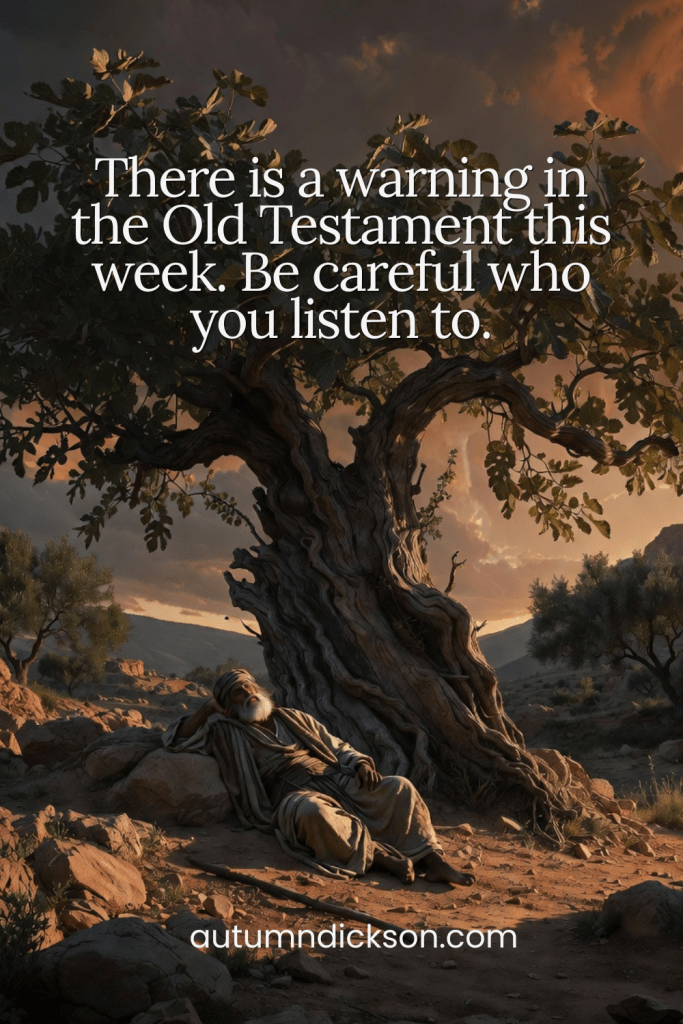
The Lord warns and commands the man of God to not eat or drink in Bethel. The man of God originally follows this command very well as he works to return to Judah. Unfortunately, another man, the old prophet, comes along and finds the man of God resting under the shade of a tree. The old prophet offers the man of God some food and drink, and the man of God refuses. The old prophet says this.
1 Kings 13:18 He said unto him, I am a prophet also as thou art; and an angel spake unto me by the word of the Lord, saying, Bring him back with thee into thine house, that he may eat bread and drink water. But he lied unto him.
The man of God listens to the old prophet and partakes in food and drink. While the man of God eats, the old prophet tells him that he won’t make it home because of his disobedience. On the way home, the man of God is killed by a lion. The old prophet collects the body, gives the man of God an honorable burial, and requests to be buried next to the man of God when he dies. The old prophet calls the man of God a brother. He testifies that the prophecy made by the man of God earlier regarding the idolatrous altar in Bethel will come true.
There are a lot of confusing details. I don’t know if this was one of those parts of the bible that was translated incorrectly or whether it’s simply highlighting the fallibility of real people who sometimes follow the Lord.
Who was the old prophet? Was he an actual prophet to the Lord? He was in the idolatrous kingdom so when they called him a prophet, was he a false prophet? Was he trying to tear down the man of God for prophesying against the northern kingdom? We know that the old prophet received some revelation from the Lord. He prophesied of the death of the man of God, and he testified of the prophecy given by the man of God. So why did he lie? Was he threatened by the man of God or did he see no harm in his white lie? Was he trying to just nourish the man of God? Was he wicked but then received a testimony while he watched the man of God come and eat?
There is a lot of ambiguity. Oftentimes, I’ll try to take one biblical theory and talk about true principles from it regardless of whether the details are perfect. This time, I’m going to embrace the ambiguity.
The man of God listened to the old prophet and found himself dead because of it.
I’ve seen a pattern on social media. This is a pattern that has existed for a long time, but I’ve seen it more readily because of its prevalence on social media.
On social media (and in real life), we find people who are disgusted by the church. They hate it. They actively fight against it. Their entire online persona can be defined by, “I hate the church.”
But there is another group of people. They claim to be part of the church, to receive revelation, and to love the Lord. Some of their posts are uplifting and encouraging, but some of their posts teach things that can be found in direct conflict with the Lord’s commandments. Some of their posts might not necessarily be in direct conflict, but they are critical of the church in the name of their love for the Lord.
These people are much more ambiguous. What are their true motives? What does it mean that they call themselves members? Because heaven knows you can call yourself a member without actually following Christ.
I don’t have any real desire to discover their motives. If they are sincere, the Lord will work with them and hopefully they will listen. If they are not sincere, then the Lord can handle all of that. I don’t need to know their motives or even condemn them.
Rather, I’d like to highlight a warning from this story. The man of God died because he followed the ambiguous old prophet who had some claim to God but also lied.
I don’t think we’ll get killed by a lion if we follow these accounts, but I do think it can spiritually deaden us. It can blind us.
Isn’t that funny? The rest of the world would call us blind and accuse us of drinking the Kool-aid, and yet, either side could be logically labelled as propaganda. Both sides label themselves enlightened. Everyone thinks their version is the closest one to the truth.
So how do we know whether we can trust the old prophet? How do we know whether we should whole-heartedly follow the prophet of our church?
I can’t answer that question for everyone. All I know is that I talk to the Lord, and He responds. I can’t answer for other people, but the more I study the gospel and the church, the more I see the Lord’s perfect hand working with the imperfection of mankind. I have watched some of my loved ones listen to these posts and believe they can disobey the Lord in little ways and be fine, and I have watched some of my loved ones turn these voices off. With the experiences that I’ve had in the gospel, I have no desire to follow anyone (real or on the internet) who tells me that I can disobey the Lord. It’s not just about avoiding dying either. I have found too much joy in the protection and safety of the Lord, and I refuse to lose that joy.
I testify that being obedient to the Lord provides safety and warmth and true happiness. I testify that even in the darkest times, following Him is where we will find respite. I testify that He teaches us through powerful stories in the scriptures, and that His patterns reflect across all generations on the earth. I testify that there is safety in joy in following the word of the Lord as given from Him directly.


Thank you for sharing sister. Convey my fathers day wishes to brother and family members ❤️
LikeLike
So grateful that I could be helpful. Happy Father’s Day to those in your family!
LikeLike
I’d say you covered many of the “what if’s” very well. In Sunday School today, the comment was made that the story of the widow of Zarephath illustrates one of the many if-then promises found in the scriptures (and the gospel). Our part is to act on the if with faith 1st, trusting that the Lord will provide the then — in His own due time.
Elijah said, if you feed me 1st, then you won’t run out or meal or oil. What if the widow had said “thanks, but no thanks”? I wonder what mental gymnastics and what ifs crossed her mind once she left Elijah until she brought his cake to him as he asked. She could have run out, been blessed by a ministering sister with more food, but for how long? We can speculate, but we don’t really know. What we do know is that she had enough faith to complete the if part and Elijah’s prophesy came true, which fed all 3 of them. While Elijah is living with the widow, her son becomes sick and she wants to blame Elijah (1 Kings 17:18). He could have said “ok, bye. See you later” what would have happened to the barrel and oil then? Thankfully, he was also a kind, loving, humble prophet who petitioned the Lord to bring the boy back to life and his prayer was answered. Completing a pretty big if at the beginning led to a HUGE then for her and her sick son.
I feel like the above fits with your story and questions about the man of God and the old prophet. The man of God was given a direct commandment (no if and no then). Not even king Jeroboam could get him to eat and drink with him! I think your comment about all the shades of darkness on social media is quite accurate. How many what ifs crossed the mind of the man of God as started for home and as he was going back to eat and drink with the old prophet? In this story, the then part came AFTER he had found excuses to not do that the Lord had commanded him to do.
For me the answer leans towards what all we mortals are prone to do — relaxing after a job well done. We start out strong, faithful and dedicated. After a while, our commitment weakens. Yes, a loving Heavenly Father is in relentless pursuit of us. (Elder Kearon April 2024), but so is Satan and those who uphold his work of destruction.
There definitely is safety in following the Lord and keeping His commandments. I am very, very grateful that sending lions to the disobedient is a very rare exception!!
Thank you again, my friend.
LikeLike
I have had many “corrections” since starting my blog that have brought me back into balance. Sometimes the Lord emphasizes His great love and mercy, and other times, He emphasizes the strictness of His words and justice. I think I have recently been leaning towards the power that is associated with exactness. There is so much power in faith and obedience. I look back at all the things I was protected from because I followed the prophet, and I see my friends who didn’t follow. They’re good people, but they fell into a lot of painful traps with many repercussions. So grateful for the prophet.
LikeLike
I am also grateful for corrections and course corrections. I think Elder Vaiangina Sikahema’s Conference address on A House of Sequential Order (October 2021) explains it very well.
I’d say you are EXACTLY right about obedience. As long as it doesn’t become the leaven of the Pharisees – which is hypocrisy. (Luke 12:1)!
LikeLiked by 1 person