August 3-9
If you prefer to listen over reading an article, keep an eye on Autumn Dickson on YouTube or various podcast platforms. I post video and podcast versions of my blog posts on my Youtube channel and on the podcast platforms: Apple, Anchor, Breaker, Google Podcasts, and Spotify.
Looking for a different week in the Come Follow Me program? Check out this link to find posts by week: https://autumndickson.com/category/come-follow-me/
The book of Esther is generally well-known. A Jewish orphan finds herself in the harem of the king, and she becomes queen after winning his favor. A plot against the Jews unfolds, and all of them are going to be destroyed. At the peril of her life, she stands before the king and invites him to the banquet to plead on behalf of her people.
It is very easy to see how Esther is a type of Christ. She intercedes on behalf of her people. She is willing to die in order to do it. She delivers the Jews from death; she gives them a fighting chance. She “rises” on the third day of fasting to go to the king on behalf of delivering her people. There are many parallels that we could talk about.
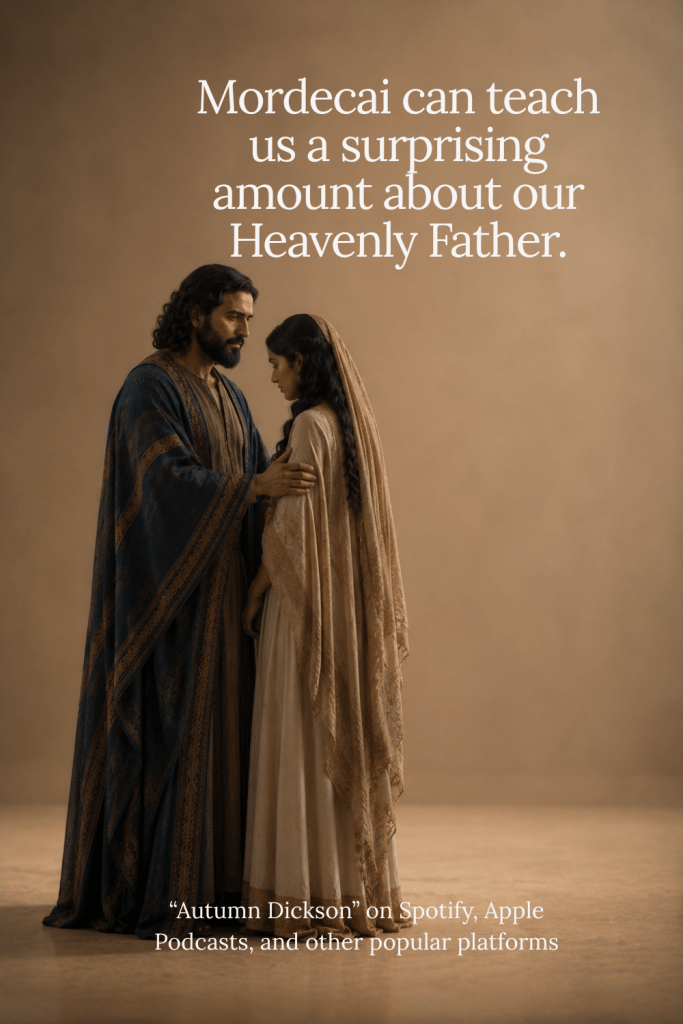
But after pondering on the fact that Esther is a type of Christ, it occurred to me that Mordecai is a type of Heavenly Father. It’s not a perfect parallel, but there are two details that point to Mordecai being a type of the Father.
Esther 2:7 And he brought up Hadassah, that is, Esther, his uncle’s daughter: for she had neither father nor mother, and the maid was fair and beautiful; whom Mordecai, when her father and mother were dead, took for his own daughter.
Esther was an orphan, and Mordecai raised her. He loved her. After Esther was taken by Persian soldiers, he walks in front of harem court to check on her everyday. In all the important ways, he was her father.
And then, of course, there was this parallel.
Mordecai asks Esther to intercede on behalf of the Jewish people. She responds that it might kill her. He responds with this verse.
Esther 4:14 For if thou altogether holdest thy peace at this time, then shall there enlargement and deliverance arise to the Jews from another place; but thou and thy father’s house shall be destroyed: and who knoweth whether thou art come to the kingdom for such a time as this?
Mordecai warns that deliverance will come from elsewhere, but that she might not escape in the king’s court. He encourages her to risk herself, and we get his famous line that suggests she had been placed in a very specific place where she was capable of saving the kingdom.
I love this little parallel too. Christ likewise asked for the cup to be passed by Him in the Garden of Gethsemane, but He willingly took it when it was presented before Him.
But it’s actually Mordecai that I want to talk about.
As Latter-day Saints, we believe that Heavenly Father and Jesus Christ are two separate Beings. If it is true, then this is actually a very important theology. Combining them into one Personage, completely eliminates the sacrifice of the Father. There is great love in sacrificing yourself; there is also immense love in allowing your loved one to be sacrificed.
But unlike with Esther, where deliverance would have risen from elsewhere, there was no one else to save us but Christ.
Heavenly Father could have stopped the atonement of Jesus Christ because of His great love for His Son, but He didn’t. He allowed Him to be sacrificed. This is no small thing, and we can’t afford to look over Heavenly Father’s sacrifice.
Mordecai understood what it meant to sacrifice a child. Despite the fact that he had likely been moved upon by the spirit to help him see that Esther had been set up to save her people, I can’t imagine that there weren’t nagging little feelings. Did Mordecai ever think, “What if I ask her to do this and I’m simply sending her to her death for nothing? What if the Lord has a different means of deliverance but Esther is simply killed because I asked her to approach the king? What if her death is my fault?”
Obviously, Heavenly Father knew what the sacrifice of Christ was really going to entail. However, Mordecai’s experience of worrying over Esther helped him get a better taste of what Heavenly Father experienced as He watched His Son suffer.
I’ve never been asked to sacrifice a child on behalf of the world or even a nation (or at all). Because I’ve never been asked to sacrifice in this manner, I can only imagine what Heavenly Father felt when He allowed the Savior to take on the sins and pains of the rest of us. Mordecai has a better understanding of what Heavenly Father went through.
Esther was separated from her family and taken into the Persian court, a place of danger and intrigue. When Mordecai asked her to go walk into that court and face death, he was asking her to do it alone. Her handmaidens fast with her, but when she truly goes in to face her death, there is no mention of anyone standing with her.
Heavenly Father likewise had to completely withdraw from His Son in order to complete the atonement. Christ had to understand what it meant to be truly rejected by God in order to fulfil the atonement completely. Not only did Heavenly Father have to ask the Savior to suffer what He did, Heavenly Father had to leave His Son to do it alone.
We cannot overlook what Heavenly Father did for us without robbing ourselves of the chance to be grateful. We cannot combine them into one Personage without running the risk of completely disregarding the sacrifice of our Heavenly Father. The story of the atonement of Jesus Christ is a story of sacrifice. Christ willingly laid Himself upon the altar, but there is One who loved Christ who also allowed it to happen.
And honestly, I rather lay down on the altar than ask my child to do it. But in the case of Heavenly Father, He couldn’t. He simply had to let Christ do it.
The atonement of Jesus Christ preaches great love in the form of self-sacrifice. It preaches love in the form of watching a loved one suffer. Is there any greater love than that?
I testify that Christ loves us and volunteered to do what He did. I testify that when Heavenly Father asked who He could send down to the earth to perform the atonement, He knew that only Christ could do so. Christ 100% volunteered, but Heavenly Father knew what He was asking for. I testify that Heavenly Father loved us enough to ask His perfect Son to do that. Between the two of Them, I can think of no greater love that has been offered to us.


Please pray for my last 4 months as missionary, I’m feeling low .
LikeLike
Sometimes the most difficult parts are the parts that make us the most glorious. Go find someone who needs to feel important. Good luck friend!
LikeLike