July 27-August 2
If you prefer to listen over reading an article, keep an eye on Autumn Dickson on YouTube or various podcast platforms. I post video and podcast versions of my blog posts on my Youtube channel and on the podcast platforms: Apple, Anchor, Breaker, Google Podcasts, and Spotify.
Looking for a different week in the Come Follow Me program? Check out this link to find posts by week: https://autumndickson.com/category/come-follow-me/
In the readings this week, we find three changes for the Jews under the kings in Persia. There were three men who helped with these changes.
First, we have Zerubbabel, a Jewish governor who worked tirelessly to build the temple.
Ezra 5:2 Then rose up Zerubbabel the son of Shealtiel, and Jeshua the son of Jozadak, and began to build the house of God which is at Jerusalem: and with them were the prophets of God helping them.
Then we have Ezra who taught the people the Law of Moses.
Nehemiah 8:2-3
2 And Ezra the priest brought the law before the congregation both of men and women, and all that could hear with understanding, upon the first day of the seventh month.
3 And he read therein before the street that was before the water gate from the morning until midday, before the men and the women, and those that could understand; and the ears of all the people were attentive unto the book of the law.
And lastly, we have Nehemiah who rebuilt the wall around Jerusalem.
Nehemiah 2:17 Then said I unto them, Ye see the distress that we are in, how Jerusalem lieth waste, and the gates thereof are burned with fire: come, and let us build up the wall of Jerusalem, that we be no more a reproach.
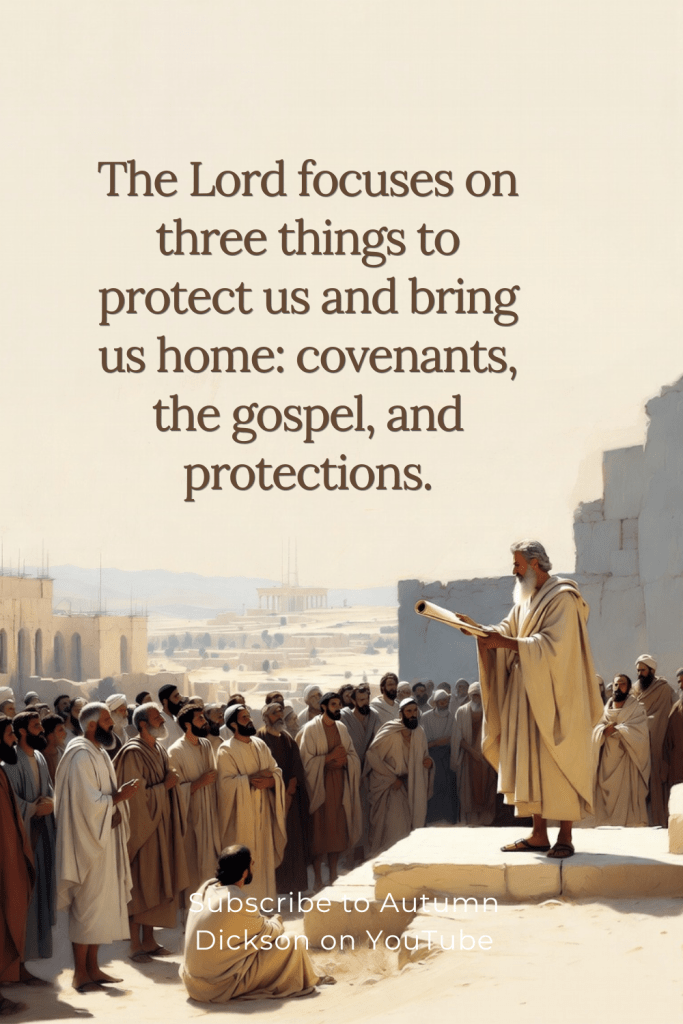
I want to talk about these three elements of the Jews returning to their homeland and why it’s so relevant to the Lord working with us in our day.
The three elements are this: covenants, gospel, and protection.
When the Lord is seeking to build us and sanctify us and bring us to Him, those are the three elements He uses.
It starts with the covenants. Covenants are promises to and from the Lord. They bind us to Him in significant ways and offer us protection. It gives us access to Christ’s power. When I think of a covenant with Christ, I always think of it in terms of marriage covenants. Christ often uses the allusion of marriage to describe His relationship with us as well.
When two people get married, they make promises to each other. They’re going to stand by each other even in imperfection and trial. Traditionally, their finances also merge. Whatever debt or surplus they bring is combined. When we enter into a covenant with Christ, we promise to stand by Him, and He promises to stand by us even in imperfection and trial. Our “finances” merge with His. All of our debt is erased by His infinite surplus but beyond that, we have constant access to that surplus to call upon in times of need or want.
This is the first step. We cannot be saved without Christ. We need to be bound to Him in a way that enables Him to save us. Hence, covenants. Hence, Zerubbabel and the temple.
The next portion of rebuilding Jerusalem was the Law of Moses. The Law of Moses is often described as the “preparatory gospel.” It helped the people start to figure out Christ and what He meant in their lives. All of the rituals and remembrances were put in place to help them better understand Christ’s role.
In our day, the Law of Moses is fulfilled and we have the gospel. The gospel, with all of its truth, is taught to us regularly so we can understand Christ in our lives. What good is being bound to Christ if we don’t know the point of Him? What good will a covenant do me if I don’t know that my sins are paid for and I don’t know that I can draw upon His strength and peace and power? We need the covenant, but we also need the information that enables us to draw upon Christ and take effect in our life.
The last portion of rebuilding Jerusalem was the wall. City walls were tremendously important. When the walls of Jericho fell, the Israelites were able to immediately take the city. The walls around Jerusalem offered protection from enemies who would want to hurt what was inside of the city.
It would be easy to put “protection” under the umbrella of covenants and gospel learning, and it would likewise be accurate to do so. Covenants protect us; covenants are our promises that allow us to call upon Christ in need. That is definitely protection. Gospel learning protects us; understanding our Savior and His love and power keeps us close to Him where we can remain safe.
But I want to separate the wall from the temple and Law of Moses readings in order to highlight specific portions of protection.
Joseph Smith taught the following regarding the gospel:
“The fundamental principles of our religion are the testimony of the Apostles and Prophets, concerning Jesus Christ, that He died, was buried, and rose again the third day, and ascended into heaven; and all other things which pertain to our religion are only appendages to it.”
The gospel (Ezra and the Law of Moses equivalent) is that the apostles and prophets testify of Christ and His mission; everything else is an appendage. The church is an appendage, an important and beautiful appendage, but it is separate. This is what I’m thinking of when I picture the wall around Jerusalem.
There are additions to the covenants and gospel that protect us. For example, commandments protect us. The Word of Wisdom protects us from all of the terrible things that can happen when you don’t have complete control over your body. The spirit of revelation protects us by warning us about certain situations or leading us towards where we need to be. There are a ton of different church programs that put us in safe and holy places to protect us.
City walls were not foolproof. Christ could make our “walls” foolproof, but part of mortality was opposition. Sometimes we leave the walls and find ourselves in trouble. Sometimes the trouble finds us even when we stay behind the walls. However, city walls still provide more protection than we would otherwise have. Not to mention, when an enemy breaches the gate, we still have complete access to our temple covenants and gospel knowledge and that heals us. The opposition hopefully pushes us closer to Christ so that no lasting damage can be done.
The stories we find in Ezra and Nehemiah have these overarching themes that point our minds back to Christ and what’s important to Him. We see His patterns. We see what He utilizes when He’s trying to build us and sanctify us: covenants, the gospel, and spiritual protective barriers.
I testify that the scriptures contain beautiful messages that teach us about God’s plans and purposes for us. I testify that Christ offers Himself to us by giving us covenants, knowledge concerning His gospel, and specific protections that build a barrier between us and our enemies. I testify that Heavenly Father thought of everything when He came up with His plan, and I testify that He is purposeful in preparing us to come home.


I was able to attend Gospel Doctrine 2 days ago where we covered these topics. One of the 1st things we did was read 2 Nephi 11:4 – all things typify Christ. We didn’t get much application of that scripture then, but I’ve been thinking a lot about how that scripture applies to Cyrus, Zerubbabel, Nehemiah, and Ezra.
The Assyrian’s and Babylonians were oppressive and tyrannical, but Cyrus was benevolent. It was pointed out that Daniel was well respected in the Babylonian court when they were conquered by the Persians and it was likely Daniel that taught King Cyrus the prophecy of Isaiah which mentioned Cyrus by name (Isaiah 44:28) 150 years in advance. That certainly seems like an attention grabber!! Like Christ, he gave the Jews freedom and liberty. He was quick to bless and slow to punish & they were loyal and loved him for doing so.
Zerubbabel, rebuilt the temple, starting with a new foundation and kept building despite opposition. Christ also wants to give us a firm foundation and won’t stop building despite our opposition.
Nehemiah, also face opposition. He stayed faithful to his mission that was an important work and could not stop and come down (likely to destruction as Lehonti found out by giving in to Amalakiah. Remaining where the Lord has placed us and resisting temptations to relax keeps us safe as well.
I was surprised at the lack of content on Ezra. He was a priest and a scribe — one of the few who could read, but he was faithful and diligent in teaching his people to repent and recommit to living the Law of Moses.
Thank you for also bringing your thoughts back to the Savior as well — walls, covenants, the gospel and protection.
Have a wonderful week.
LikeLike
Your words to keep building despite opposition were much appreciated. How is it that I always forget the simplest principles?
It’s also interesting that you bring up Ezra being a scribe. I’m six months ahead in Come Follow Me right now, and I JUST prepared a message about the scribes. They were extremely well-versed. Because they lived in a theocracy, the scribes also had legal authority due to their knowledge. It’s interesting to think about the implications for Ezra and the work he was doing. His authority was very different than what we see today where church and state are separated.
LikeLike