October 12-18
If you prefer to listen over reading an article, keep an eye on Autumn Dickson on YouTube or various podcast platforms. I post video and podcast versions of my blog posts on my Youtube channel and on the podcast platforms: Apple, Anchor, Breaker, Google Podcasts, and Spotify.
Looking for a different week in the Come Follow Me program? Check out this link to find posts by week: https://autumndickson.com/category/come-follow-me/
In Isaiah 61, we find a mission statement for Jesus Christ. In those verses, Christ talks about the reason His Father sent Him here to the earth. There are many prophecies about Jesus Christ, but He chose this prophecy specifically when the time came for Him to announce His divine Sonship and mission during His mortal life.
Isaiah 61:1-2
1 The Spirit of the Lord God is upon me; because the Lord hath anointed me to preach good tidings unto the meek; he hath sent me to bind up the brokenhearted, to proclaim liberty to the captives, and the opening of the prison to them that are bound;
2 To proclaim the acceptable year of the Lord, and the day of vengeance of our God; to comfort all that mourn;
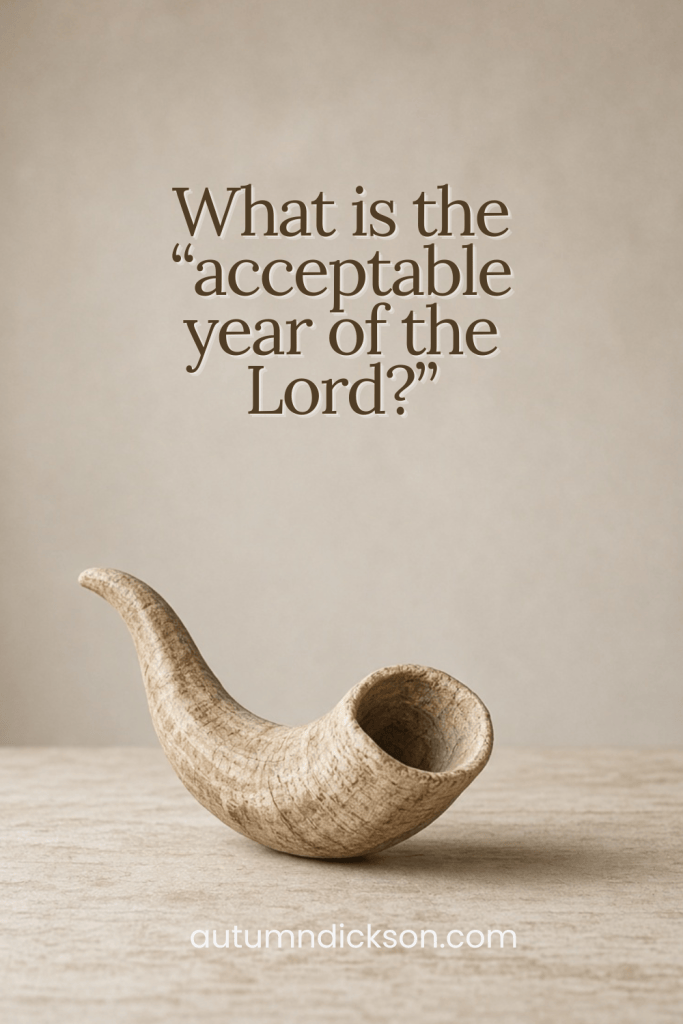
There is one phrase in particular that I want to talk about: “to proclaim the acceptable year of the Lord.” I did not understand what this specific phrase meant until this study.
The year is not a calendar 365 day year. Rather it is a word to describe a season of God’s grace, redemption, and favor. It is acceptable because it aligns with God’s merciful will for His children. Christ’s life was that season of grace.
It also holds allusions to a very specific ritual in the Law of Moses: the year of Jubilee. This was a radical social and economic practice that is detailed in Leviticus 25. Essentially, every 7th year was a Sabbath year where the land would rest and not be farmed, and debts and slaves were given relief. After 7 cycles of 7 years (the 50th year) on the 10th day of the 7th month, a ram’s horn would blow.
With that blow of the ram’s horn, some incredible things would happen. Any land that had been sold or leased or lost due to debt or poverty would revert back to the original family owners. The land belonged to God, not individuals. This prevented permanent loss of family inheritance and cycles of generational poverty. Individuals could not actually sell their land permanently because they believed the land belonged to God; they could only lease the land and the right to harvest the crops. The year of Jubilee would end all leases so when people were leasing out the land to cover financial hardship, they would agree on a price depending on how many harvests were left before the Jubilee.
Going along with the land debt reversion, Hebrew indentured servants (people who had to sell themselves in order to service to pay debts) were set free and returned to families and ancestral lands. You couldn’t lose your inheritance or yourself.
There was also a land reset. The land would rest for a second year (the normal 7th year cycle and then the 50th year); there was no sowing, reaping, or harvesting. This signalled deep trust in God’s provision. People ate what naturally grew from the fields, and there was a promise of bountiful harvest in the sixth year to cover the needs of the people.
First of all, what a cool concept. What incredible protections for His people. They could work hard and keep their dignity and take care of their debts, but they couldn’t permanently lose everything. That is definitely a year of Jubilee, an acceptable year of the Lord. Unfortunately, the people didn’t really follow this part of the Law of Moses. It was never regularly or successfully implemented in ancient Israel. However, Jubilee can be applied on the most important level whenever we desire. It can happen spiritually.
When we observe the mortal life and mission of Jesus Christ, we can see why the announcement of the beginning of the Lord’s ministry would also be called an acceptable year of the Lord.
Because of Jesus Christ, we do not have to permanently lose our ancestral inheritance for ourselves or for future family members. We are given new opportunities to live lives that are as rich as anyone else’s. Permanent loss was completely prevented even if there were seasons of hardship and servitude and repentance; you can’t permanently lose everything.
And because of the atonement of Jesus Christ, our families are protected as well. We see spiritual poverty amongst families all the time. The children suffer because of what their parents lost. In a world without Christ’s atonement, justice would still take everything from these children despite the fact that they were set up for failure. The atonement allows Christ to judge mercifully and circumstances into account rather than holding hard, fast lines of justice.
Indentured servants were freed. Not only could you not lose your inheritance, you didn’t have to lose yourself. You could be your own steward again. No one could keep racking up debts against and keep you indentured forever. Think about what that meant for a person who went through these celebrations of Jubilee. You walk away from that indentured servitude, hopefully grateful to God for setting up a society that prevented you from being a slave forever. Hopefully, you walked away with the understanding that God’s foresight and planning allowed for you to come home. Hopefully, you recognize His grace, rejoice in His goodness, and work to be a good steward. You look at your freedom compared with your servitude, and you choose to do something worthwhile with that freedom.
And then, of course, the land reset. We rejoice in the freedom offered to us. Every Jubilee year, the poor would theoretically (since it wasn’t really fully implemented) be given this deep sense of awe and gratitude at the Lord’s mercy. However, it’s not just the poor who rely on the Lord. Even the rich need the Lord, and the land reset would have given them an opportunity to learn that same lesson: their deep dependence on the mercy of the Lord. In a year of no sowing, reaping, or harvesting, they had to trust that the Lord would do exactly as He promised. He would provide for them.
I testify that the acceptable year of the Lord has come. Because of Christ’s mortal ministry, servants are freed, inheritances are restored, and none of us need be in permanent poverty. We have a deep dependence on the Lord regardless of whether we spend entire sabbatical Sabbath years allowing the land to rest. Recognizing that deep dependence is a blessing for us. It gives a safety net in a world that can take everything. I am so grateful for what Christ paid to bring about this Jubilee.

