October 26-November 1
If you prefer to listen over reading an article, keep an eye on Autumn Dickson on YouTube or various podcast platforms. I post video and podcast versions of my blog posts on my Youtube channel and on the podcast platforms: Apple, Anchor, Breaker, Google Podcasts, and Spotify.
Looking for a different week in the Come Follow Me program? Check out this link to find posts by week: https://autumndickson.com/category/come-follow-me/
Jeremiah was the prophet at a time when the Jews were to be conquered by Babylon. He was called to be a prophet and cry repentance. He was to warn the Jews about what was coming, and he also gave messages of hope. The Jews would one day be restored to the land.
The Lord also gives Jeremiah a peculiar object lesson.
Babylon had already started to take over the land of the Jews and were making a siege against Jerusalem. Then this happens.
Jeremiah 32:6-7
6 And Jeremiah said, The word of the Lord came unto me, saying,
7 Behold, Hanameel the son of Shallum thine uncle shall come unto thee, saying, Buy thee my field that is in Anathoth: for the right of redemption is thine to buy it.
Jeremiah has prophesied that Jerusalem would fall. He, more than anyone, knew that Jerusalem would not prevail. He, more than anyone, knew the land was worthless.
Let it also be known that Babylon had already taken over Anathoth. They had not yet conquered Jerusalem completely, but they had conquered Anathoth. Jeremiah’s uncle comes, and he’s like, “Jeremiah, buy this land that isn’t really mine anymore.”
And yet, the Lord tells Jeremiah to buy the land. Jeremiah does so. He pays 17 shekels for it. It is recorded and done with witnesses. Despite the fact that Jeremiah is in prison for prophesying the destruction of Jerusalem, he buys the worthless piece of land.
Perhaps the Lord sent Hanameel to Jeremiah because the Lord knew that Hanameel was going to need the 17 shekels. Perhaps it was because the Lord also wanted to teach a significant lesson.
Let’s talk about poignant details.
In Israelite tradition, all of the land belonged to God. It was divided up as inheritances to families, but it truly all belonged to God. When you ran up debts or needed money, you had to sell the land to your family first. If that didn’t work, you would lease that land to others but then the land would be restored to the family clan during the year of Jubilee. Bottom line: the land actually already belonged to God.
Because of wickedness, that land was taken over by the enemy.
And though the land prices had plummeted, silver stayed precious. Silver was the currency in Babylon as well. While everything else in the economy had gone nuts, silver retained its inherent value. There is archeological evidence of people hoarding silver during turbulent times. Silver stayed precious. The land was worth nothing.
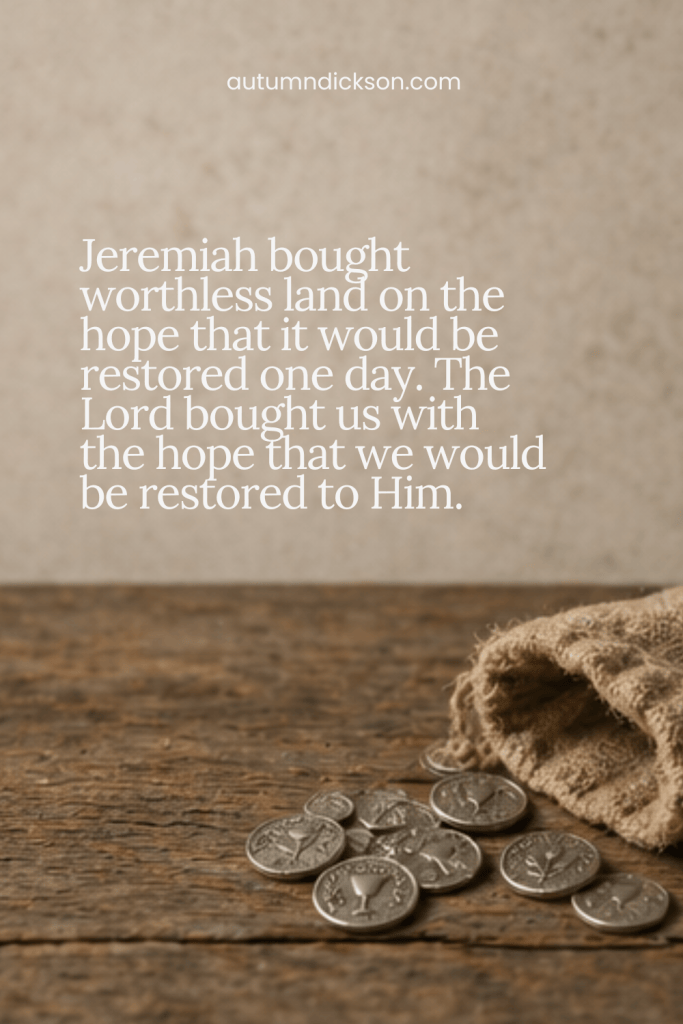
But Jeremiah bought the worthless land with his precious silver.
This was meant to be a radical act of faith. It was supposed to be this object lesson that the Jews would return one day. Everything seemed hopeless, and for a time, things were hopeless. However, it would not remain that way. It’s an object lesson and it’s the traditional lesson that we pull from this story.
But I think it goes deeper than that.
Like the land, we already belong to God. We came from Him. We are His spirit children. We are here because He brought us here.
Because of sin, we found ourselves captured and conquered and separated from loved ones. We had our inheritance taken away from us. The enemy prevailed.
Our Brother, our family member, had that first “right of redemption.” Jesus Christ had the right to redeem and keep us in the family.
Despite the fact that we are largely worthless, He used His precious blood to pay for us. He bought us. Jeremiah paid for the land with 17 shekels. The number 17 means, “overcoming the enemy” in the bible.
Christ has already paid the price, and the land is bought. Unfortunately, we are still a part of Babylon for a while until everything is restored. We don’t bring much value yet, but like this land, we were bought on the hope of redemption. Christ paid for us with deep hope that we would be restored to Him.
The scriptures are just really awesome, ya know?
The more I study these stories, the more I see Jesus Christ. There are many good principles that we pull from these stories. There are principles of wisdom and charity and forgiveness and mercy and justice and hope and so on and so forth. There are many principles that can lead us towards good lives.
But I keep finding Christ in these stories. He is everywhere. His victory is taught in all of the details of these stories. I love finding Him again and again and again.
Perhaps those who recorded the words in the bible did not fully understand what they were writing about, but I testify that the Lord did. He knew what He was doing when He asked Jeremiah to buy a worthless piece of land. He knew that we needed to learn good principles to help us build happy lives, but more importantly, He knew we needed to know what He did for us in order to find happiness and peace. I testify that He bought us, as worthless and conquered as we were. I testify that He bought us based on the simple hope that we would one day be restored to the family because of how much He loves us.

