October 26-November 1
If you prefer to listen over reading an article, keep an eye on Autumn Dickson on YouTube or various podcast platforms. I post video and podcast versions of my blog posts on my Youtube channel and on the podcast platforms: Apple, Anchor, Breaker, Google Podcasts, and Spotify.
Looking for a different week in the Come Follow Me program? Check out this link to find posts by week: https://autumndickson.com/category/come-follow-me/
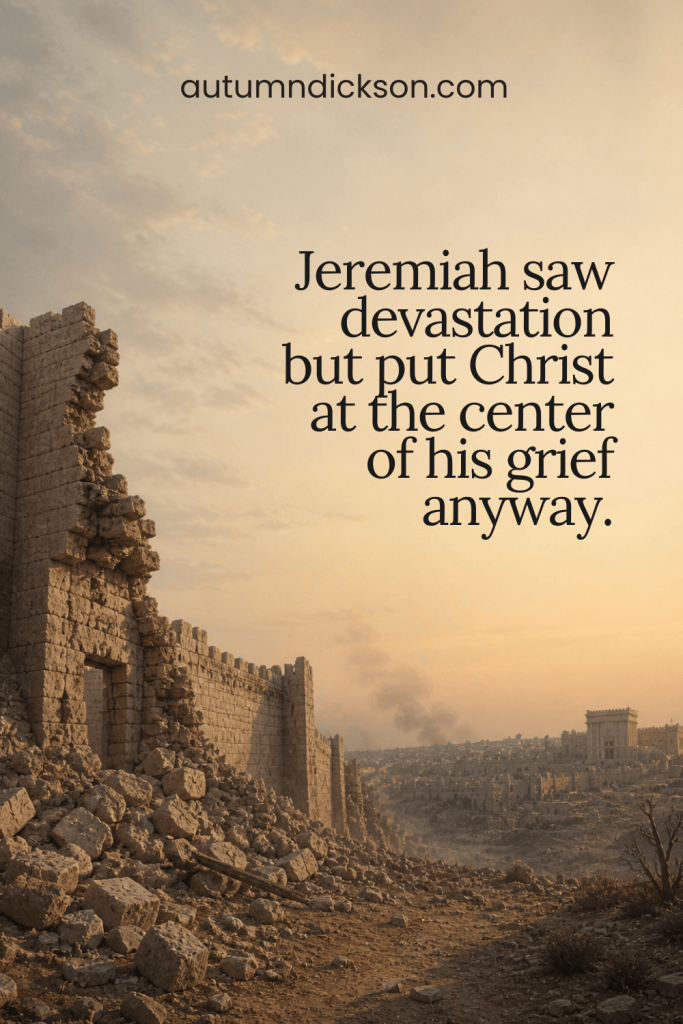
One of the books we study this week is called Lamentations, and there is a really good reason it is called Lamentations. Jeremiah was a prophet who had pleaded with the people to repent. He pleaded with King Zedekiah to listen, but Zedekiah refused. Jerusalem was surrounded and sieged. The fall of Judah was…awful. It was known as one of the worst sieges and disasters in ancient history. It was brutal even by the standards of the ancient Near East. There is evidence of the horror from biblical text as well as Babylonian records.
Some survivors described it as worse than what happened to Sodom. Some believe that the victims who died by the sword were more blessed than those who were left to rot away in the city that was under siege. There was no food or water. The dead were piled up in the streets, and there was no escape. Not to be irreverent, but cannibalism is even recorded. I share that with the sole purpose of highlighting the devastation.
You were stuck in a city that was dying, not sure if what awaited you outside the walls was any better than what you found within. When the walls were finally breached, there was prolific assault. People were taken from their homes and banished away. Only the most desperate poor were left within the city. The city and temple were burned. The trauma lasted for generations.
What a horrible time to be called as prophet. I can’t imagine being asked to plead with people to repent, learning to love them as I served them, and then having to bear witness of their fall. We read Jeremiah’s record, but Lamentations is also believed to be written by Jeremiah.
Lamentations is not strictly a history; it is a collection of Hebrew poetry. Hebrew poetry has a couple of defined characteristics that help us better understand what the poet is trying to express. The first couple chapters are called acrostics. Each verse goes in the order of the alphabet. So in English, this would look like the first letter starting with “A,” the second verse starting with “B,” and so on and so forth. This helped people remember the poems better.
Acrostics also had cultural significance. In the case of Lamentations, Jeremiah’s sorrow was so profound over watching Jerusalem fall that acrostics symbolized the complete and total devastation he was experiencing. You go through the entirety of the alphabet; you go through the entirety of desolation.
Chapter 3 is a triple acrostic. It goes through each letter three times.
Chapter 3 is also significant because of a phenomenon known as chiasmus. You say something in the beginning, your most important highlighted point is found in the middle, and then you repeat what you said in the beginning backwards. The pattern is: ABC – pinnacle – CBA. In English, you often find the point at the end of the story or poem. This is not the case in Hebrew poetry.
The entire book of Lamentations also utilizes chiasmus, and chapter 3 is the pinnacle. Then you have chapter 3 as an individual chapter; it also has a mini chiasmus within the big chiasmus that is Lamentations.
In other words, chapter 3 in Lamentations is a big deal. It is the pinnacle of Lamentations as a whole. It has its own chiasmus, and it is a triple acrostic. In other words, according to Hebrew poetry, Jeremiah has something important to say.
So what did Jeremiah say in this pinnacle of pinnacles? What do we find at the center of the chapter that is the center of the book?
What would be your center point if you were Jeremiah? What would you choose to record for future generations? What would you share?
Chapter 3 in Lamentations begins and ends with the pain and devastation that Jeremiah is experiencing over Jerusalem being destroyed. This is understandable. I’m sure Lamentations was part of how Jeremiah processed some of the trauma that was occurring before his own eyes, a trauma that he had tried to prevent. I wonder if Jeremiah ever felt like he had failed.
And yet, despite everything that Jeremiah must have been feeling, he didn’t put pain in the middle. I will share a couple of the verses at the center.
Lamentations 3:21-23
21 This I recall to my mind, therefore have I hope.
22 It is of the Lord’s mercies that we are not consumed, because his compassions fail not.
23 They are new every morning: great is thy faithfulness.
Against all odds, Jeremiah shares a message of hope and eternal persistence in reaching out to the House of Israel. The verses continue on for a little while before becoming somber again.
Jeremiah had listened to the Lord and been thrown into prison for it. He had been forewarned about what Jerusalem faced. He had glimmers of hope where Zedekiah sought him out, but never actually ended up listening to Jeremiah. Then, as declared by the Lord, Jeremiah had to watch what happened in Jerusalem.
What devastation are you facing? What are you putting at the center of your life? What are you focusing on? It is okay to see the devastation and work to process it. It is okay to be heartbroken and torn apart and mourn. Jeremiah did this on both sides. But what are you putting at the center of it all?
I testify that putting Christ and His promises at the center of everything will bring hope even in the darkest of times. Jeremiah was sent to the earth at a painful time, but the promise of the Messiah was a light. He believed it enough to sacrifice everything, and those cries of hope at the center of his grief and trauma are evidence of that belief. Christ is what enabled him to be okay in the end, and I testify that Christ can carry you through whatever devastation you are witnessing or carrying.

