July 20-26
If you prefer to listen over reading an article, keep an eye on Autumn Dickson on YouTube or various podcast platforms. I post video and podcast versions of my blog posts on my Youtube channel and on the podcast platforms: Apple, Anchor, Breaker, Google Podcasts, and Spotify.
Looking for a different week in the Come Follow Me program? Check out this link to find posts by week: https://autumndickson.com/category/come-follow-me/
Asa is one of the kings we read about this week. He was a king of Judah, the southern kingdom. He starts out his reign really strong, tearing down idol worship and deposing his own grandmother who worshipped idols. He encouraged people to seek the Lord. Unfortunately, he also took a turn for the worse and started trusting in human solutions over God, and he died.
There is one verse in the midst of his story that I want to share.
2 Chronicles 14:6-7
6 And he built fenced cities in Judah: for the land had rest, and he had no war in those years; because the Lord had given him rest.
7 Therefore he said unto Judah, Let us build these cities, and make about them walls, and towers, gates, and bars, while the land is yet before us; because we have sought the Lord our God, we have sought him, and he hath given us rest on every side. So they built and prospered.
Asa had a time of peace during his reign, and in the midst of this peace, he built fortified cities in Judah.
Asa goes on to face an Ethiopian army, and he is vastly outnumbered. As he faces his enemy, he cries out to God.
2 Chronicles 14:11 And Asa cried unto the Lord his God, and said, Lord, it is nothing with thee to help, whether with many, or with them that have no power: help us, O Lord our God; for we rest on thee, and in thy name we go against this multitude. O Lord, thou art our God; let not man prevail against thee.
The Lord proceeds to smite the Ethiopians, and they are driven back.
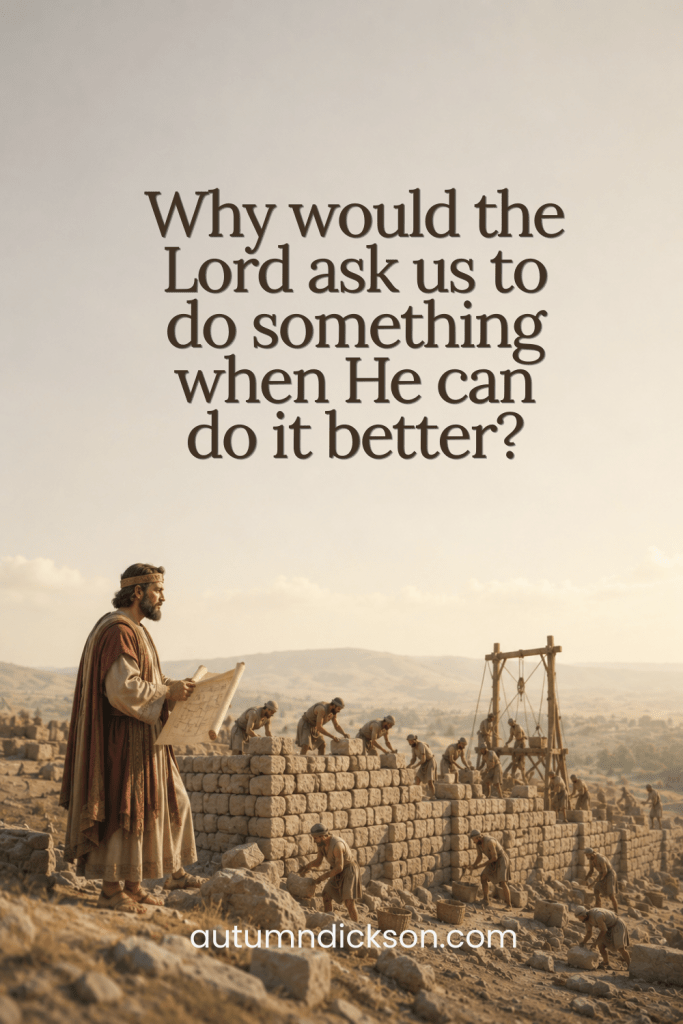
So here is my question…why did they fortify their cities?
Over and over and over again in the Old Testament we read about this same pattern. The Israelites (or in this case, Judah specifically), do all of the things only to have the Lord completely fight their battles.
The Lord parted the Red Sea. He made the walls of Jericho come down. He struck down 185,000 Assyrians outside Jerusalem’s walls during Hezekiah’s reign. This is a consistent pattern throughout scripture. The Lord fights the battles. Entire armies are defeated or become confused or simply flee.
So why bother even fortifying the cities?
Even in this specific story where the Lord defeats an army of a million Ethiopians, it doesn’t say that the fortified cities made a difference in the slightest. So why? Why fortify the city when the Lord defeats the enemy?
The only way I can think to explain it is this: chores.
Every Monday, our house gets totally cleaned. Bathrooms, mopping, dusting, vacuuming, all of it. Then, throughout the week, my three oldest kids are assigned one chore a day. It is usually the same list of chores that is done on Monday.
I remember watching my four year old wipe down the mirrors in the bathroom on Tuesday. That mirror went from clean to streaked in no time flat. My soul kinda died a little bit watching her make the mirror dirtier, and then it died a little more when I had to sneak back in to clean it a third time in two days.
But. I have to remind myself that it’s not about a clean mirror. It’s about a healthy, growing child. She doesn’t clean the mirror so that I can have a clean mirror (obviously). She cleans the mirror so that she learns how to clean a mirror (eventually).
The Lord paid for our sins. He paid for the sin you committed years ago, the sin you committed yesterday, the sin you’re going to commit today, and the sin you’re going to commit years into the future. The mirror is already clean.
But He still asks us to learn how to clean a mirror. Even when we’re actually just making the mirror dirtier again or when we’re cleaning an already clean mirror.
Being saved means you’re clean again, and to some extent, all of us will be saved in some degree of glory. Being saved means you’re clean, but being exalted means you grew up.
And that’s important because it determines our level of happiness.
There is inherent worth in knowing how to clean a mirror. There is inherent worth in learning how to fortify your city and do labor. There is inherent worth in growth even if it’s not actually contributing to anything yet. There is inherent worth in work even when it’s not paying for our salvation.
The Lord saves us. He cleaned the mirror. He protected His people throughout the scriptures.
But He asks us to learn how to clean the mirror because we won’t find happiness unless we know how. Some of the most miserable people I know are the ones who don’t appreciate the value of working hard. It won’t do you much good for the Lord to save you if you’re still miserable, and He’s not going to hook you up to constant happy drugs in heaven. Where do you think happiness comes from? It doesn’t really come from the mirror simply being clean. It comes from growing, and the clean mirror enables you to live with God again.
So we follow the Lord and His commandments so we learn how to be happy, and then He pays for the whole experience. He cleanses us so we can return to live with Him, and we return with the knowledge and experience required to find deep and lasting joy.
I’m grateful for the scriptures that teach true doctrine. I’m grateful that I get to watch these patterns over and over and over throughout the Old Testament. The Lord does the work, but then He asks us to grow. I see it everywhere. I’m grateful He paid the price for me to get messy and come home with the knowledge and experience I need. I’m grateful that I get to learn, through my own experience, the good from the evil. I testify that the Lord saves, and I also testify that He gives commandments for our good.


So why bother even fortifying the cities? I’m glad you answered your own question — inherent worth. It wasn’t just about walls, but training, weapons and armor too. It’s our part of being saved by grace, after all we can do.
I loved the analogy of cleaning mirrors!! Truly profound!
Amen to working hard. Our family grew up on 10 acres of citrus, date palms, 1 horse, pig and, chicken pens so every day was workday. If my parents didn’t have enough work for 6 boys, my maternal grandparents lived on 15 acres just to the north. The habits I learned then have served me very well during my working career as an electrician.
I have been thinking about crossroads a lot lately. It extends what I just wrote to you about choices excluding other choices. Twice a month, I come to a crossroad — pay my tithing or buy something else. Put some money away in my savings account or spend it. We face crossroads during tense (and happy) moments with our friends and family. We can add to the tension and happiness or detract from it. Since my mother came to live in my home, I have watched more Hallmark and very similar movies these past 9 months than in my entire life. In every movie there comes a crossroad where one or the other has to decide to leave where they are and go somewhere else, usually without their love interest. Generally, but not always, love wins. We face daily crossroads in our discipleship, just like the kings of Judah and Israel. The road of apostasy seems to be built into our DNA, but so is the road of becoming more Christlike!! Every day we move closer to our Savior or farther away from him. I am thankful the message of the Old Testament (and of Asa) is that there is always a way back.
Christ will never forsake or abandon us.
Best wishes always.
LikeLike
Sometimes I think I want to start a homestead farm on our land. I love the idea of my kids receiving that same kind of profound education of hard work and getting the job done. It makes my soul sing to think of it. On the flip side, I really like air conditioning and I’m already overwhelmed with my blog. Maybe I’ve romanticized it anyway haha or maybe it’s in my future. I hope chickens are in my future at the very least.
Your mother is a lucky woman and not just because you watch Hallmark with her! So grateful to “know” you!
LikeLiked by 1 person