July 13-19
If you prefer to listen over reading an article, keep an eye on Autumn Dickson on YouTube or various podcast platforms. I post video and podcast versions of my blog posts on my Youtube channel and on the podcast platforms: Apple, Anchor, Breaker, Google Podcasts, and Spotify.
Looking for a different week in the Come Follow Me program? Check out this link to find posts by week: https://autumndickson.com/category/come-follow-me/
This week, we find a righteous but imperfect man surrounded by legitimate reasons to be afraid. How do you respond when you’ve been backed into a corner? Let’s talk about how Hezekiah responded.
Hezekiah was a righteous king especially when contrasted with his wicked father, Ahaz. When Hezekiah rose to the throne, he threw out all of the idolatry and tore down all of the false places and altars of worship. He was reforming Judah, and he was helping them repent and turn back to the Lord.
Assyria was a superpower in the ancient world. They had just dominated the northern kingdom of Israel, and they set their sights on Judah next.
I am a firm believer that the Lord protects the righteous. It’s one of the main themes of The Book of Mormon, and yet, we see something interesting happen here. Judah is not completely protected. Assyria is able to take some of their fortified cities, and Hezekiah responds by offering to pay them a tribute to go away. In order to afford the tribute required by Assyrian, Hezekiah strips the temple.
It doesn’t work. Assyria sticks around.
One of the Assyrian commanders comes to the walls of the city and starts speaking in Hebrew so that the people of Jerusalem can fully understand the danger they’re in. It’s psychological warfare, and the people respond with silence as instructed by Hezekiah.
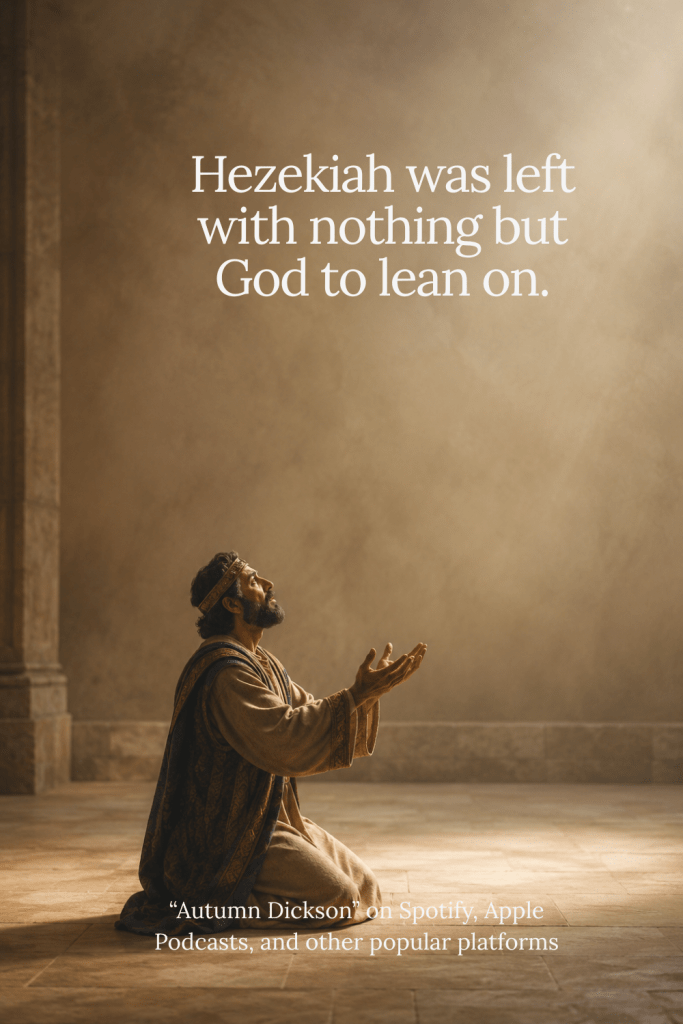
Hezekiah responds differently this time. He covers himself in sackcloth and ashes and goes to the temple to pray to the Lord. He prays and tells the Lord, “They’re mocking Thee. Show them who You are.” The Lord does. He slays 185,000 soldiers in the Assyrian army, and Sennacherib goes home to be assassinated by his sons.
We get to see Judah change and repent at this particular period in time. There are many good details; let’s cover a few.
Detail one. The Lord allows Assyria to defeat some of the fortified cities in Judah.
Judah was in the process of repenting. Hezekiah had torn down a lot of the idolatry, and this was incredible faith. Unfortunately, Judah had a long history of turning away from the Lord. Losing these cities was not an indication of the Lord being powerless. It was about discipline so that Judah could learn.
I actually find it really poetic that the fortified cities were conquered, but Jerusalem remained. What was in Jerusalem?
The temple.
The kingdom of Judah was being stripped down to its center, specifically to that covenant relationship that it held with the Lord.
I’ve seen this kind of repentance in my own life. I didn’t actually recognize it until a couple of days ago as I sat in my car in a parking lot. There was once a time when the Lord dismantled huge parts of who I used to be in order to make way for more important things.
Music used to be the most important thing in my life. I would drive down the highway, listen to some good country songs, and I always felt like I was on fire. It was such a strong feeling. So much of my identity revolved around music. There were a lot of reasons I was worried about getting married and starting a family, but I actually think music was a huge portion of those reasons. I didn’t want to sacrifice music.
Music was taken away from me. I stopped college to try and be a musician. I was working in the industry. I was entering competitions and playing small shows. I did it for months. Then it all collapsed a bit. I was surrounded by darkness, both within my own mind and in what I had surrounded myself with.
After being separated from that dark period, I put up a barrier between me and music. It didn’t touch me like it used to. I couldn’t write anything anymore. It was too associated with darkness.
As I sat in my car pondering this, I found myself bawling my eyes out that the Lord had taken it away. Only, I was bawling in gratitude not in despair. Music is powerful and wonderful and I don’t think I’m done with it yet. However, it had become an idol to me. I needed it taken away because the Lord had something much more important in mind. If I had kept music, regardless of whether I was successful or not, I think it would have prevented me from fully stepping into more divine callings. I wouldn’t have had room for these other things that the Lord wanted to give me.
Would I have willingly chosen children or resented them? Would I have ever had time to bear my testimony in the capacity that I do now? Would I even have been able to enjoy my role as a wife as much as I do now if music hadn’t been taken away from me?
I can’t totally be sure, but I think music would have robbed me of those things. I was that obsessed. It was an idol. I know that’s not the case for other musicians, but it was for me. It would have kept me from some of the most important parts of my life.
As I think about the beautiful life I’ve been given, it makes me sick to think that I could have missed it.
The Lord stripped away all of these parts of me that felt so important, and He left just Himself and His covenant with me. With all of the problems I had accumulated combined with the music having been taken away, there wasn’t much of me left. Just a covenant.
And the Lord upheld that covenant. He somehow got me on a mission and gave me my family. He had to remove all of that other stuff so that He could build something better with nothing but the covenant protection He had given me.
Detail two. Hezekiah goes from stripping the temple of riches to praying in it.
Hezekiah originally tried to give money over to Assyria to get them to leave, and it didn’t work. They camped outside of Jerusalem. He doesn’t make the same mistake twice. Hezekiah receives a letter telling him, “Don’t trust anyone who tells you that your God can save you. We’ve defeated so many other gods before you.”
Hezekiah had overturned altars and torn down idolatrous images in Judah; he did all the things. Now he gets to prove how much he really trusts the God of his fathers. Hezekiah tells the Lord that the Assyrians have done all of these major feats of strength and power, but Hezekiah also acknowledges that it is only the power of mankind. He continues his beautiful prayer with this sentiment.
2 Kings 19:19 Now therefore, O Lord our God, I beseech thee, save thou us out of his hand, that all the kingdoms of the earth may know that thou art the Lord God, even thou only.
He implores the Lord to show the Assyrians who the true God is.
This isn’t about saving his own skin anymore. Hezekiah’s heart has turned towards God’s glory. That is the result he wants: God’s glory.
God shows up with a whole lot of glory, and He shows Judah and the rest of the world who holds the real power.
Hezekiah repented. He spiritually up-levelled. He went from knocking down idols to facing fear with nothing but his trust in God’s covenants with Judah. He went from fear of losing his life and kingdom to simply wanting the glory of God. He stood to lose a lot in facing off with Syria, but he chose trust and it saved him.
I testify that a covenant relationship with Christ is a powerful foundation. I testify that sometimes the Lord strips away parts of us that feel so important so that He can uncover that foundation and start anew with something more powerful. I testify that spiritually maturing means stepping into trust, and I testify that trusting in God saves us. It’s not enough to keep the commandments and do the things. Hezekiah did the things, and they were SO important and necessary, but even that was not enough. Hezekiah still had to trust, and that was what turned the tides of Judah. It can turn the tide for you.


Greetings from Skagway, AK
Detail one. The Lord allows Assyria to defeat some of the fortified cities in Judah…… This is evidence that an omniscient Heavenly Father also allows bad things to happen to good people. Prophets are killed. Illness & disease afflict righteous men, women & children. His only begotten Son was crucified. 185,000 soldiers following orders die camping outside Jerusalem because a General insulted the God of Israel!
As far as stripping down & dismantling, when Brad Wilcox spoke at a BYU Hawaii devotional, he spoke about place holders. Sometimes, before God can give answer our prayers, He needs to have a place in our hearts to put it. He had prayed to decades to understand why his father had left the family when he was young. It wasn’t until he had young boys of his own that the amswer came….. “Now that you are a father, now that you know a father’s joys and love, would you be the son who lost his father? Or the father who lost his son?” (Bread or Stones: Understanding the God We Pray To
By S. Michael Wilcox, March 31, 2009)
Ooooo….. another country music lover! Welcome to the club?
In the book I told you in was reading, The Infinite Atonement by Tad R. Callister, he talks about how the Lord marks time, He doesn’t! No watch no calendar. Everything is before Him, past, present & future. It’s not about what you & I did yesterday or will do tomorrow. He just sees & loves us with an Infinite love. He is happy when we spiritually level-up!
This was excellent as usual. Have a great week my friend.
LikeLike
I’m going to need to read that book. I’ve owned it for a while, but I haven’t been able to jump into it yet. Right now, I’m busy reading marketing books so I can help my husband with his company haha wish me luck!
I love the idea of placeholders. I have seen that in my life often enough. I’ve even felt that. There have been times when I’ve felt like the Lord has told me I’m not ready to understand or ready to move forward, etc., etc. I have felt Him tell me to be patient until I’m ready.
And yes. I have loved country music ever since I heard Blake Shelton’s “Austin,” on a camping trip in Tyler, Texas. It’s my favorite type of music!
LikeLike
I have enjoyed reading that book very much!! Our choices rule out other choices. Reading this book means I am not reading others. Paying tithing means I can’t spend that money on other things. However, I don’t regret it at all. Helping your husband is a very noble endeavor and you will both reap the rewards of your investment.
Placeholders are definitely a blessing in my life as well. I am very thankful the Lord provided the spaces in my heart when I really needed them.
I remember an outdoor summer concert decades ago where Dierks Bentley was an opening act!! He really rocked the house. I like hearing the modern covers of really old country songs. It’s definitely my favorite. A few years ago, I started going back to Country Thunder here and in Wisconsin — where my daughter lives.
LikeLike
I would love to see Dierks Bentley!!! I’m so so jealous! Cover bands are also a favorite over here!
LikeLiked by 1 person