August 24-30
If you prefer to listen over reading an article, keep an eye on Autumn Dickson on YouTube or various podcast platforms. I post video and podcast versions of my blog posts on my Youtube channel and on the podcast platforms: Apple, Anchor, Breaker, Google Podcasts, and Spotify.
Looking for a different week in the Come Follow Me program? Check out this link to find posts by week: https://autumndickson.com/category/come-follow-me/
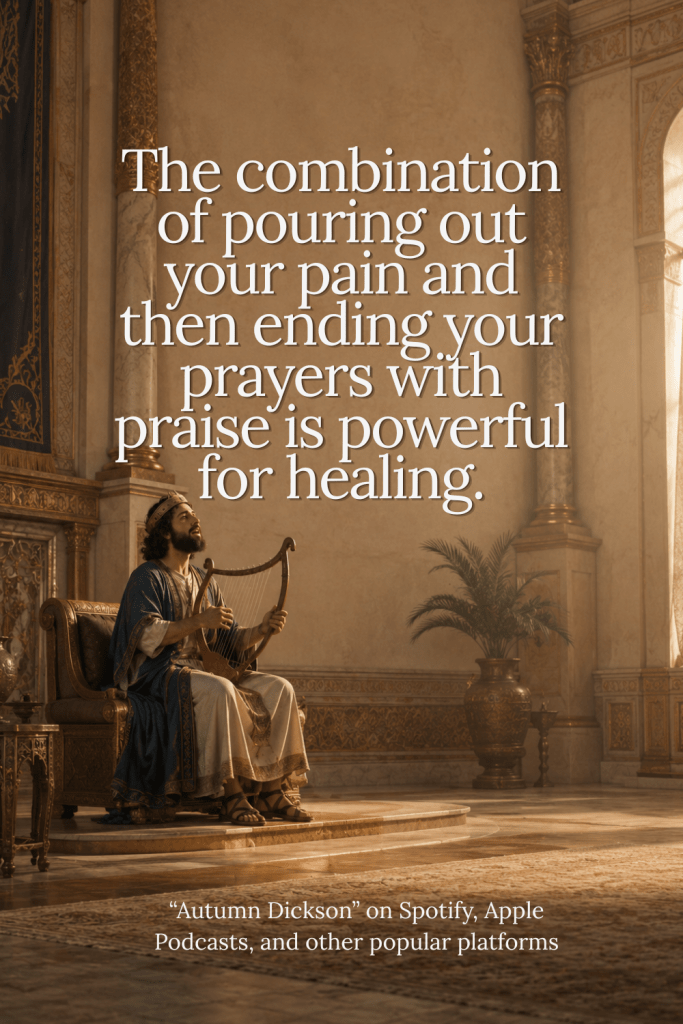
One of the most emotional psalms found in the Old Testament was written by David. He was a king who worshipped and loved the Lord. He rejoiced in the Lord, and because of that, he sometimes found himself with enemies. His enemies were not just foreigners but within his own kingdom. This chapter often speaks of them. Though David pours out his heart over his suffering, it shifts towards the end of the psalm towards praise of the Lord.
Psalms 69:30-31
30 I will praise the name of God with a song, and will magnify him with thanksgiving.
31 This also shall please the Lord better than an ox or bullock that hath horns and hoofs.
Before these verses, David is emotionally suffering. He is in deep need. He is flooded by difficulty, overwhelmed by it. It shifts to asking the Lord to protect him from his enemies, but then it takes an interesting detour. Despite his turmoil, David starts to praise God.
There are two parts that I want to talk about.
Part one: Truly pour out your heart to God, but then try ending it with sincere, heartfelt praise. Do this on purpose.
The Lord is not afraid of your strong feelings. Tell Him exactly where you’re at. Tell Him how afraid you are, uncertain, angry, exhausted, depressed. We do not have to muffle our despair to please Him.
But after we’ve been open with Him, can I recommend praising Him? During your prayers, make the same shift that David does. Start to praise the God who has showed up for you a million times before. No matter how much despair you’re holding, it’s not going to change the fact that the Lord has already won and will provide for your eternal happiness. He’s going to do that regardless. Praising Him doesn’t change anything except you; it changes you. When you start to praise Him, you remember. Your eyes are opened. Your problems start to seem small and pathetic because you suddenly remember the character of the God who is on your side.
The tricky part about this recommendation is that it has to be heartfelt. Otherwise, it does more harm than good. If you’re just trying to swallow your pain and “force” yourself into faith, you’re not going to find the peace. That’s not how you arrive at peace.
So tell Him how you feel and then remind yourself of Who is on your side by praising Him on purpose.
Part two: There is a reason David says the Lord appreciates praise more than an extra sacrifice.
In verse 31, he declares that this specific attitude (praising God despite turmoil) will please the Lord more than the ox or bullock that has horns and hoofs. This description is important. It is describing the highest quality sacrifice that one could make. It was a fully-developed, prime animal. It was costly and ritually perfect, but according to David, thanksgiving was more pleasing.
It is important to note that David participated in sacrifice. He believed in obedience. This verse describing the Lord’s approval of thanksgiving doesn’t diminish our need to do what the Lord asks. However, doing what He asks without letting it change you is just a fruitless exercise for everyone involved. This verse is emphasizing the entire purpose of sacrifice in the first place. It’s meant to turn our hearts to the Lord. David understands why he makes sacrifices.
This is very pleasing to the Lord.
When I think about what is pleasing to the Lord, I often think about what would please me as a parent.
Would I love it if my daughter came to me randomly and said that she had vacuumed downstairs? Absolutely. I would be grateful if I asked her to do it, and she complied. I would be even more grateful if she did it before I even asked.
But I think there’s another experience that would mean more to me.
If my daughter felt overwhelmed with persecution and trials, I would be honored if she came to me about it. David’s heart cries out to God in the beginning. This psalm isn’t just about thanksgiving. David also lays out every reason he has that would argue against gratitude. I imagine any of my children coming to me, talking about painful circumstances, but then ending with, “I know things are hard, but thanks for being my mom. Thanks for taking care of me at home and making sure I have what I need. I know I can trust you.”
I can understand why David believes that the Lord appreciates David’s trust and praise more than another sacrifice.
Not only does it please the Lord to have His children love Him for all He’s done for them, this attitude of praise also pleases Him because He gets to watch us find happiness from the practice of praise.
I love when my kids recognize what I do and are grateful. I love it because it feels good on a personal level, but I also love it because I know that attitude of praise and gratitude and trust are going to lead to happy lives. That’s how you get there, and I get so excited when my kids find it.
It is so cleansing and cathartic to do as David does. It feels so good to pour out your heart to God but then step back and truly believe that you’re going to be okay, not because of your own merit but because of the Lord’s. If I could watch my children (or any of my loved ones) find what I’ve found, what David has found, my soul would be satisfied.
Do it. Pour your heart out and then end it with praising Him.
I testify that the Lord has your best interest at heart, and He has all the power and wisdom in the world to bring it about. I testify that praising Him pleases Him because it enables you to be happy. He loves watching you be happy. I testify that as we consciously take time to praise Him, we find peace and joy.


Your message reminded me of the Psalm of Nephi in 2 Nephi 4. It has always been an important lesson to me to see how Nephi dealt with his feelings of wretchedness, sorrow and grief (vs 17). He goes on feeling poorly for 2 more verses – temptations that easily beset him (vs 18) and a heart that groans because of his sins (vs 19).
Beginning with verse 20, Nephi starts counting his many blessings. He recalls the support and love of God, the confounding of his enemies, hearing his cries, knowledge by visions. He recalls being carried away upon exceedingly high mountains, where his eyes beheld great things. The knowledge of his sins didn’t magically disappear, he reminded himself that his heart was broken and his spirit contrite (vs 32).
He uses only three verses feeling sorry for himself and sixteen remembering the goodness of God!!
I have used this pattern many times during my own sorrow and grief.
It was Elder Maxwell who taught “In conclusion, the submission of one’s will is really the only uniquely personal thing we have to place on God’s altar. The many other things we “give,” brothers and sisters, are actually the things He has already given or loaned to us. However, when you and I finally submit ourselves, by letting our individual will be swallowed up in God’s will, then we are really giving something to him! It is the only possession that is ours to give”. (Swallowed Up in the Will of the Father Oct 1995)
Thank you for blessing me once again. Keep the office open.
LikeLike
That is one of my favorite parts in The Book of Mormon because we get to see how Nephi matured. I could be completely misunderstanding Nephi, but I see myself in him a lot. I often put myself as a “hero” in stories as I was growing up, and there came a point when I realized that I was just as much a beggar before God as anyone else. I wasn’t bad. I just didn’t have my eyes open yet. I love that Nephi included that really vulnerable part of himself.
LikeLike