August 17-23
If you prefer to listen over reading an article, keep an eye on Autumn Dickson on YouTube or various podcast platforms. I post video and podcast versions of my blog posts on my Youtube channel and on the podcast platforms: Apple, Anchor, Breaker, Google Podcasts, and Spotify.
Looking for a different week in the Come Follow Me program? Check out this link to find posts by week: https://autumndickson.com/category/come-follow-me/
There are different kinds of scripture that reach us through different means. The Book of Mormon is filled with stories that teach us about the dealings of God with His children; it is also filled with sermons that teach doctrine. The Old Testament is likewise filled with stories that highlight our relationship with Christ. The New Testament teaches us about the character of Christ by helping us read about His mortal life. The Doctrine and Covenants show the voice of the Lord as He speaks to His children; He answers questions that they have. There are obviously other kinds of scripture in each book, but there are some general “types” of scripture that teach us in different ways.
The Psalms are different entirely; they are poems set to music. Oftentimes, they are simply filled with praise and worship. When I think of Psalms, I think of the times when I feel very close to God. When I write in my journal about ways that God has shown up for me or saved me, it often evolves into psalms. I tell whatever story has happened in life at that point, but then I shift a bit and simply start to rejoice in Him and praise Him and love Him for helping me.
The principle I want to talk about today was taught to me a few weeks ago as I listened during Relief Society. The Lord whispered a principle to me, and today I saw that principle again in the verses that I read. Here is that verse.
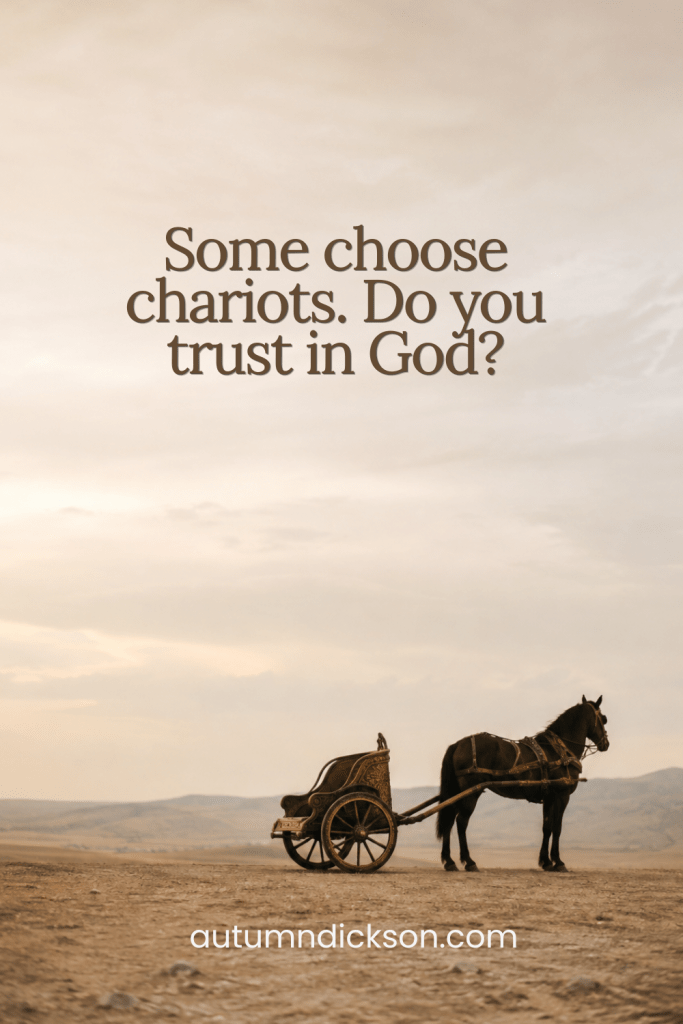
Psalms 20:7 Some trust in chariots, and some in horses: but we will remember the name of the Lord our God.
Upon first reading this verse, we learn that the Lord is more powerful than human technology and resources. Chariots and horses were the epitome of military technology when this psalm was written. Many leaders measured their power by how many chariots they had. Even the most advanced of mankind was negligible compared to the glory of God and the safety that He could offer to us. There is so much comfort and peace to be had when we shift our trust from earthly protections to the Lord.
But as I read this verse, a different principle jumped to mind.
Chariots and horses were tools of war. In our day, we do not use chariots and horses to go into battle. In fact, many of us aren’t going into battle at all.
Or are we?
There is spiritual warfare being waged right and left of course, but this specific verse doesn’t suggest that the Lord is fighting. There is plenty of scripture that teaches how the Lord will fight our battles, but this particular verse doesn’t say that. It specifically teaches that instead of trusting in war, we remember the Lord.
Instead of trusting in anger and defensiveness, we remember the Lord.
Perhaps you will not find yourself on a chariot, but you may find yourself in battle against someone who has hurt you. You feel a deep need to defend yourself and hold desperately to your anger. You are possibly presented with opportunities to fight back with sophisticated technology.
Or you can choose to remember the Lord.
I have heard forgiveness mocked in our day and age. I have heard anger praised and upheld as the savior of victims.
There are appropriate times to be firm and even “battle” for what’s right, but righteous anger and firmness is always accompanied by forgiveness. Forgiveness is what will really save you when you feel that war has been waged against you. Forgiveness may include pursuing justice and standing up for what’s right, but forgiveness is required if we want to truly find healing and be at peace once again.
As mentioned previously, rather than emphasizing the fact that the Lord will fight your battles, this verse simply implores you to remember Him.
As I sat in Relief Society a couple of weeks ago, the Lord whispered to me one of the purposes of a specific part of His atonement. This is a very specific example, but it can be extended to countless examples.
I have never been assaulted.
So I would imagine that giving a TED Talk and starting a speaking circuit about forgiveness addressed to assault victims wouldn’t go far. These women are extremely vulnerable. Their trust has been shattered. Why would they give their trust to me about how to heal? I’ve never been where they’ve been. I have no personal experience in that kind of healing. I have no personal idea of what’s going to make them feel safe again. Honestly, the audacity of me to set myself up as an example to follow would be arrogant.
But then imagine an assault survivor starting a speaking circuit about healing and peace. It’s going to hit really different. If these vulnerable women can look to this speaker who has been where they’ve been and can show them the way out of darkness, they’re going to trust this speaker.
This is part of the reason Christ suffered what we suffered. He wanted to be able to teach us with power. He wanted to be able to stand before us, healed and whole, and show us the way out. He wanted to be able to say, “I know exactly how you feel. You can trust Me and what I teach about healing.”
When Christ asks us to forgive, it’s because He knows the peace that it brings firsthand.
When we are faced with any kind of battle or war or violence against us, it helps to remember the Lord. It helps to approach the situation with the Lord as our teacher and our guide out of darkness. He knows what He’s talking about. When He asks us to forgive and love, it’s because He personally knows what that will do for us.
I testify that the scriptures can teach us how to survive mortality. I testify that they are full of the teachings of Christ that can enable us to come out on top. I testify that remembering Christ and what He went through can help us to trust Him and allow Him to lead us out of whatever pain we may be experiencing. I testify that He suffered on our behalf because He loves us and wanted that extra relatability and power to reach us.


……. that he may know according to the flesh how to succor his people according to their infirmities. (Alma 7:12)
Assault victims who share their stories of resilience, empowerment and recovery are able to do the same thing — provide succor. The same goes for those who have overcome addictions, through 12 Step Programs and other means. Those who have been in recovery for months, years or decades provide hope and a light of healing to others who are just beginning to confront demons with a desire to become more like their mentors. In doing so, we engage in behaviors that mirror the Savior’s. “That which we persist in doing becomes easier for us to do, not that the nature of the thing itself has changed, but that our capacity to do is increased” (Ralph Waldo Emerson). As we “lift up the hands which hang down”, (Heleman 12:12) we become better at it. Like the Savior, who didn’t receive a “fullness at first but continued from grace to grace until he received a fullness.” (D&C 93:13). This same pattern works for all those to persist in doing.
On the topic of forgiveness, I thought of the statement by Elder Jeffery R Holland…… “surely the thing God enjoys most about being God is the thrill of being merciful, especially to those who don’t expect it and often feel they don’t deserve it.” (Laborers in the Vineyard April 2012). I have experienced this for myself on a much lower level. Being able to forgive someone, even when he or she shows no repentance or remorse, does provide a thrill. The thrill of a heavy burden being lifted from the forgiver’s shoulders.
Chariots are objects that are acted upon. They cannot act or move for themselves to do good or evil. They are tools in the hand of the driver, who can also control the path of a horse or horses and use them for good or evil to plow a field, carry mail across miles of prairie. He or she can use the Chariot for war or the same chariot to rescue and transport the injured for potential lifesaving treatment.
Yes, the Lord knows what He is talking about & so do you. Thanks for another wonderful message.
LikeLike
I love your addition of being a type of Christ when we reach in and serve those we have felt similarly to, and I completely understand your sentiment on the thrill of forgiving. It really does feel good to let it be and walk away. It’s the most powerful thing you can do to take care of yourself in those kinds of situations.
Also very insightful on the chariot being an object that is acted upon!! Love it. Thank you, friend.
LikeLiked by 1 person